A Stay on the French Riviera
Bordered by the Mediterranean Sea and backed by the first foothills of the Alps, the French Riviera combines seaside resorts, historic towns, hilltop villages and sun-drenched landscapes. Its glamorous reputation represents only one aspect of a region also shaped by Provençal markets, modern art, maritime traditions and a deeply Mediterranean way of life.
Nice, the Heart of the Riviera
Nice is often the best starting point for exploring the region. The Promenade des Anglais follows the curve of the Bay of Angels, while Old Nice is filled with narrow streets, colourful façades, Baroque churches and traditional shops. The Cours Saleya is especially known for its flower market and stalls selling local products.
Castle Hill offers sweeping views of the city, the harbour and the coastline. Nice also has an outstanding artistic heritage. Museums dedicated to Henri Matisse and Marc Chagall reflect the importance of Mediterranean light in the work of many painters.
Cannes, Antibes and Saint-Tropez
Cannes is internationally associated with its film festival, the Palais des Festivals and La Croisette, which is lined with prestigious hotels and beaches. The Le Suquet district preserves an older atmosphere, with sloping streets and views over the harbour. Offshore, the Lérins Islands provide a peaceful setting. Sainte-Marguerite is known for its fort, while Saint-Honorat is home to a monastic community and vineyards.
Antibes has an old town surrounded by ramparts overlooking the sea. The Château Grimaldi, now the Picasso Museum, recalls the artist’s time in the town. Cap d’Antibes is known for its villas, coves and coastal paths, while Juan-les-Pins is more closely associated with beaches, nightlife and jazz.
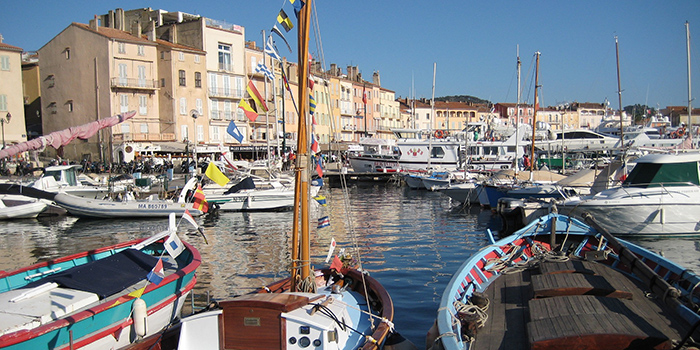
Saint-Tropez owes much of its fame to artists, cinema and the international jet set. Behind the yachts and luxury boutiques, visitors can still find a former fishing harbour, a citadel and traditional Provençal streets. The famous Pampelonne beaches are mainly located in the neighbouring municipality of Ramatuelle.
From Villefranche-sur-Mer to Menton
East of Nice, the coastline becomes steeper and more dramatic. Villefranche-sur-Mer is built around a deep natural harbour, a colourful port and an old town squeezed between the sea and the mountains. Saint-Jean-Cap-Ferrat is known for its coastal walks, elegant properties and the Villa Ephrussi de Rothschild.
Èze occupies a spectacular position on top of a rocky outcrop. Its vaulted passages, stone houses and exotic garden make it one of the region’s most visited villages. Farther east, Monaco includes the Prince’s Palace, the Rock of Monaco, the Oceanographic Museum and the modern towers of Monte Carlo.
Near the Italian border, Menton is distinguished by its mild climate, gardens and citrus fruits. Its old town rises above the shore in a cluster of warm-coloured façades. The Basilica of Saint Michael the Archangel and the Lemon Festival are among its best-known landmarks.
Hilltop Villages and the Hinterland
The hinterland reveals a quieter and more rural side of the French Riviera. Several villages have preserved their walls, covered passageways, shaded squares and artisan workshops.
-
Saint-Paul-de-Vence is known for its art galleries, ramparts and the Maeght Foundation, which is devoted to modern and contemporary art.
-
Grasse is a major historic centre of perfume production, especially associated with roses, jasmine and tuberose.
-
Vence has a fortified old town and the Rosary Chapel, designed and decorated by Henri Matisse.
-
Gourdon overlooks the Loup Valley from a rocky promontory offering extensive views towards the Mediterranean.
-
Sainte-Agnès, above Menton, is a hilltop village located only a short distance from the coast.
The Sea, Beaches and Natural Areas
The beaches of the French Riviera are not all sandy. Nice is mainly bordered by pebble beaches, while Cannes, Juan-les-Pins and the Gulf of Saint-Tropez have more stretches of sand. Elsewhere, small coves are hidden between headlands and cliffs.
The Estérel Massif, easily recognized by its red rocks, forms a striking contrast with the blue sea. It is a popular destination for hiking, cycling and boat excursions. Cap d’Antibes and Cap Ferrat also have coastal paths that allow visitors to explore the shoreline on foot.
Farther inland, Mercantour National Park includes Alpine valleys, lakes, forests and high mountain peaks. The Valley of Wonders is particularly known for its ancient rock carvings. The proximity of the sea and the mountains makes it possible to travel quickly from Mediterranean beaches to Alpine landscapes.
Art and Major Events
The French Riviera has attracted many important artists. Matisse and Chagall are associated with Nice, Picasso with Antibes and Vallauris, Renoir with Cagnes-sur-Mer, Fernand Léger with Biot, and Jean Cocteau with Menton and Villefranche-sur-Mer. Their works can be seen in museums, chapels and decorated buildings throughout the region.
The Riviera also hosts several internationally recognized events:
-
The Cannes Film Festival transforms the city into an international centre of cinema every spring.
-
The Nice Carnival is known for its floats, parades and flower battles.
-
The Menton Lemon Festival features enormous sculptures made from citrus fruits.
-
Jazz à Juan reflects the important place of Juan-les-Pins in the history of European jazz.
Flavours of the French Riviera
Local cuisine is based on olive oil, vegetables, herbs, fish and sun-ripened produce. A traditional Niçoise salad combines tomatoes, eggs, anchovies or tuna, olives and raw vegetables. Socca is a thin pancake made from chickpea flour.
Other regional specialities include pissaladière topped with onions and anchovies, petits farcis stuffed vegetables, fougasse bread, tapenade and fish soup. In Menton, lemons are used to flavour desserts, jams and liqueurs. Local markets are also good places to discover fruit, vegetables, cheese, olive oil and handmade products.
Getting Around and Choosing When to Visit
Trains provide convenient service along much of the coastline, including Cannes, Antibes, Nice, Monaco and Menton. They help visitors avoid traffic congestion and the parking difficulties that are common during the high season. Buses serve several villages, while a car makes it easier to explore the hinterland.
July and August offer the greatest amount of activity, but they also bring large crowds, high temperatures and higher prices. Spring and early autumn generally provide pleasant weather and a quieter atmosphere. Winters remain mild along the coast, although some tourist activities operate on a reduced schedule.
Quiz questions preview
-
Which of these places is located in the Monte-Carlo Quarter of Monaco?
The Prince's Palace | None of these responses | The Louis II Stadium | The Oceanographic Museum -
Where is the prestigious Hôtel de Paris located?
Nice | Cannes | Monaco | Saint-Tropez -
The French army owns 95% of this large island which is part of the Hyères Archipelago.
Porquerolles | Port-Cros | Île d'Or | Levant Island -
In which part of Antibes is one of the most prestigious jazz festivals in the world?
Juan-les-Pins | La Salis | Le Fournel | Saramartel -
In which city does the most prestigious film festival in the world take place?
Monaco | Nice | Venice | Cannes