Renaissance - The Italian Enlightenment
The Italian Renaissance was a period of profound artistic, intellectual and scientific renewal that transformed Europe between the 14th and 16th centuries. Born in the great cities of the Italian Peninsula, it was driven by the rediscovery of Greek and Roman antiquity, the rise of humanism and the support of wealthy patrons. Florence, Rome, Venice and Milan became centres of creation where artists sought to represent the world with greater realism, depth and balance.
The Origins of the Renaissance
-
The word “Renaissance” refers to the idea of a rebirth of ancient culture after the Middle Ages.
-
The movement took shape in Italy, where the remains of ancient Rome and classical manuscripts were especially present.
-
Italian cities grew wealthy through trade, banking and exchanges across the Mediterranean.
-
Their prosperity allowed powerful families, princes and the Church to support artists and scholars.
-
Competition among the cities encouraged the construction of prestigious palaces, churches and monuments.
-
The Renaissance did not completely break with the Middle Ages, but gradually transformed its traditions.
Humanism
-
Humanism placed human beings, their education and their abilities at the centre of intellectual thought.
-
Humanists studied Greek and Latin texts to rediscover the ideas of ancient authors.
-
They were interested in philosophy, history, poetry, politics and morality.
-
Petrarch is often considered one of the forerunners of humanism.
-
He searched for ancient manuscripts and encouraged the study of classical authors.
-
Humanists valued eloquence, critical thinking and knowledge of ancient languages.
-
Their ideas did not necessarily reject religion, but they gave greater importance to the potential of the human mind.
Florence, Cradle of the Renaissance
-
Florence was one of the main centres of the Italian Renaissance.
-
The city was wealthy because of the textile trade and banking.
-
Its political institutions and influential families encouraged artistic commissions.
-
The Medici family played a central role in Florentine cultural life.
-
Cosimo de’ Medici and Lorenzo the Magnificent supported artists, architects and thinkers.
-
The Medici also used patronage to strengthen their prestige and power.
-
Florence became a place where art, money, politics and culture were closely connected.
Patronage
-
Patronage refers to the financial support given to artists and scholars.
-
Patrons commissioned religious works, portraits, palaces and public monuments.
-
Popes, princes, merchants and religious brotherhoods were among the main sponsors.
-
An artistic commission was often intended to express the faith, power or wealth of the person financing it.
-
Artists therefore depended heavily on their protectors.
-
The prestige of certain creators eventually became great enough to give them greater freedom.
-
During the Renaissance, the artist began to be regarded as an exceptional creator rather than a simple craftsman.
The Rediscovery of Antiquity
-
Renaissance artists studied the sculptures, buildings and writings of antiquity.
-
They sought to recover the harmony, proportions and balance associated with Greek and Roman art.
-
Mythological subjects reappeared alongside religious themes.
-
Ancient gods, heroes and stories became sources of inspiration.
-
Architecture revived columns, arches, domes and the classical orders.
-
Artists did not merely copy antiquity, but adapted it to the needs of their own time.
Perspective
-
Linear perspective made it possible to represent depth more convincingly.
-
It is based on the idea that parallel lines appear to converge at a vanishing point.
-
Filippo Brunelleschi played an essential role in its development.
-
Leon Battista Alberti later explained its principles in a treatise.
-
Perspective transformed painting by creating the illusion of a coherent space.
-
Figures could now be placed within believable and orderly architectural settings.
-
The technique combined mathematics with artistic observation.
Brunelleschi and Architecture
-
Filippo Brunelleschi was one of the great architects of the Early Renaissance.
-
He designed the dome of the Cathedral of Santa Maria del Fiore in Florence.
-
Building such a vast dome represented a major technical challenge.
-
Brunelleschi used a double-shell structure and innovative construction methods.
-
The dome became a symbol of Florence and of Renaissance genius.
-
He also designed buildings characterized by simple geometric forms and regular proportions.
-
His architecture contrasted with the vertical emphasis and decorative complexity of the Gothic style.
Donatello and Sculpture
-
Donatello profoundly renewed Florentine sculpture.
-
He studied ancient models while seeking strong individual expression.
-
His bronze David was one of the first major freestanding nude statues created since antiquity.
-
The figure is distinguished by its relaxed posture and youthful appearance.
-
Donatello also used very shallow relief to create an impression of depth.
-
His sculptures often express the energy, emotion and personality of their subjects.
-
He helped free sculpture from its dependence on architecture.
Botticelli
-
Sandro Botticelli was one of the most famous painters of the Florentine Renaissance.
-
His works combine elegance, movement and poetry.
-
The Birth of Venus depicts the goddess arriving on the shore in a shell.
-
Primavera brings together several mythological figures in a garden.
-
These paintings reflect the return of subjects inspired by antiquity.
-
Botticelli nevertheless retained a more linear and less realistic style than some later artists.
-
His figures are distinguished by their graceful silhouettes and melancholic faces.
Leonardo da Vinci
-
Leonardo da Vinci embodied the ideal of the Renaissance man.
-
He was a painter, engineer, inventor, anatomist and observer of nature.
-
He studied the human body through drawing and dissection.
-
His notebooks contain studies of movement, water, flight, machines and anatomy.
-
The Mona Lisa is famous for its smile, gaze and mysterious atmosphere.
-
Leonardo used sfumato, a technique producing soft transitions between forms and shadows.
-
The Last Supper depicts the moment when Christ announces that one of his disciples will betray him.
-
The composition organizes the apostles’ reactions around the central figure of Jesus.
Michelangelo
-
Michelangelo was a sculptor, painter, architect and poet.
-
He considered sculpture his principal art.
-
His David represents the biblical hero before his battle against Goliath.
-
The statue expresses concentration, strength and mastery of the human body.
-
The Pietà shows the Virgin Mary holding the body of Christ after the Crucifixion.
-
Michelangelo painted the ceiling of the Sistine Chapel at the Vatican.
-
The central scenes depict the Creation, Adam and Eve, Noah and the Flood.
-
The Creation of Adam has become one of the most famous images in the history of art.
-
He later painted The Last Judgment on the altar wall.
Raphael
-
Raphael is known for the balance, clarity and harmony of his compositions.
-
He worked in Florence before being summoned to Rome.
-
Pope Julius II commissioned him to decorate several rooms in the Vatican.
-
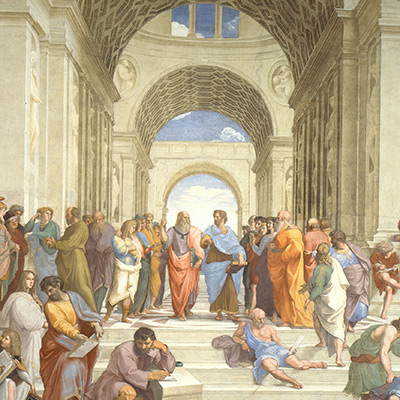
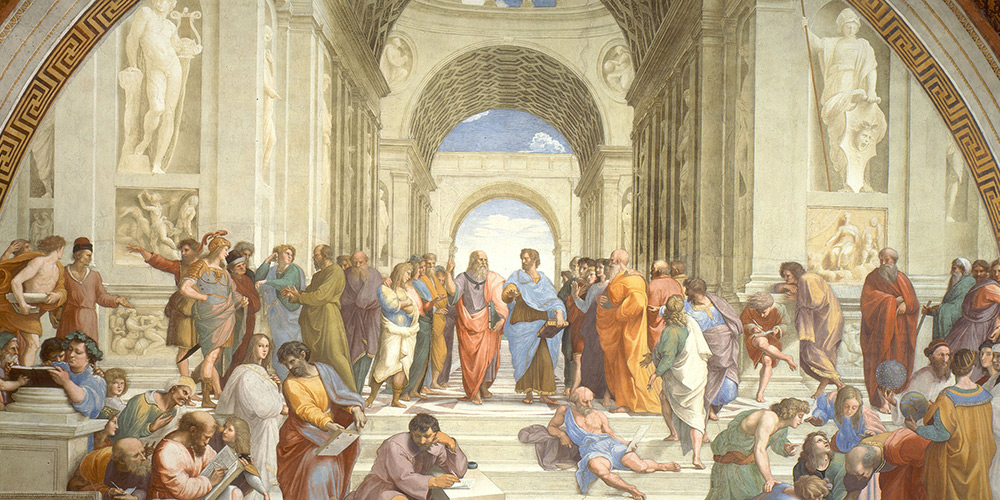
The School of Athens depicts the great philosophers of antiquity within a monumental architectural setting.
-
Plato and Aristotle occupy the centre of the composition.
-
The fresco celebrates philosophy, reason and the transmission of knowledge.
-
Raphael also painted many representations of the Virgin and Child.
-
His works had a lasting influence on European art.
The High Renaissance
-
The High Renaissance was a period of major artistic achievement during the early 16th century.
-
Rome became an important centre of artistic creation.
-
Popes Julius II and Leo X commissioned vast projects.
-
Leonardo, Michelangelo and Raphael were regarded as the leading figures of the period.
-
Artists sought a balance between ideal beauty, observation of nature and expressive power.
-
Compositions became grander, more complex and more technically accomplished.
-
This brilliant period was relatively brief.
Rome and the Popes
-
Renaissance popes used art to strengthen the prestige of Rome and the Church.
-
They ordered the rebuilding of St. Peter’s Basilica and the transformation of the Vatican.
-
Julius II supported Michelangelo, Raphael and Bramante.
-
Papal commissions often combined religious faith with political ambition.
-
Rome became an enormous construction site attracting artists from across Italy.
-
Papal patronage helped produce masterpieces, but it also required considerable financial resources.
-
Church spending and certain practices contributed to some of the criticism that led to the Protestant Reformation.
Venice
-
Venice developed an artistic tradition distinct from those of Florence and Rome.
-
Venetian painters placed great importance on colour, light and atmosphere.
-
Humidity and the characteristics of the buildings encouraged the use of oil paint on canvas.
-
Giorgione created poetic works whose meaning sometimes remains mysterious.
-
Titian became one of the greatest portraitists and colourists of the Renaissance.
-
His paintings are distinguished by their rich tones and free brushwork.
-
Tintoretto used daring perspectives and dramatic movement.
-
Veronese created vast scenes filled with sumptuous settings and elegant figures.
Portraits
-
Portraiture developed significantly during the Renaissance.
-
Princes, merchants, intellectuals and noblewomen wanted to leave lasting images of themselves.
-
Painters did not seek only physical resemblance.
-
They also tried to represent the sitter’s social rank, personality and ambitions.
-
Clothing, jewellery, objects and backgrounds provided information about the person portrayed.
-
Portraiture reflected the growing importance given to the individual.
The Study of the Human Body
-
Artists studied the body to better understand its proportions and movements.
-
Direct observation and dissection contributed to advances in anatomy.
-
Leonardo da Vinci produced highly detailed drawings of muscles, bones and organs.
-
Michelangelo gave his figures remarkable physical power.
-
Nudity returned to art as a symbol of beauty, heroism or vulnerability.
-
This search for the ideal body was inspired by antiquity while also relying on a renewed observation of nature.
Science and Technology
-
The Renaissance encouraged observation, experimentation and the study of the natural world.
-
Advances in mathematics supported architecture, cartography and perspective.
-
The printing press made it possible to reproduce books more quickly and at lower cost.
-
Ancient texts, humanist works and scientific discoveries could circulate more widely.
-
Maps became more accurate through exploration and new measuring methods.
-
Art and science often remained closely linked.
-
Artists studied optics, geometry, anatomy and the properties of materials.
The Italian Wars
-
The Italian Peninsula was divided into several rival states.
-
Florence, Venice, Milan, Naples and the Papal States defended their own interests.
-
Beginning in the late 15th century, the Italian Wars drew in foreign powers.
-
France, Spain and the Holy Roman Empire competed for control of certain territories.
-
The conflicts weakened several Italian cities.
-
The Sack of Rome in 1527 deeply affected contemporaries.
-
Political instability helped spread Renaissance artists and ideas throughout Europe.
Mannerism
-
Mannerism developed after the High Renaissance.
-
Artists moved away from the classical balance associated with Raphael and Leonardo.
-
They used elongated bodies, complex poses and sometimes unrealistic colours.
-
Spaces could appear unstable or deliberately artificial.
-
Pontormo, Bronzino and Parmigianino were among the leading Mannerist artists.
-
The style often expresses elegance, tension and technical virtuosity.
-
It demonstrates that the Renaissance did not follow a simple progression toward ever greater realism.
The Legacy of the Italian Renaissance
-
The Italian Renaissance permanently transformed painting, sculpture and architecture.
-
It strengthened the importance of the individual artist and personal reputation.
-
Perspective, the study of the body and the return to ancient models influenced all of Europe.
-
Humanism encouraged new ways of studying history, languages and society.
-
The works of Leonardo, Michelangelo, Raphael and Botticelli continue to shape the popular image of the Renaissance.
-
The period laid several foundations of modern art, science and thought.
-
Its legacy remains visible in museums, Italian cities and Western ideas about beauty and creative genius.
Quiz questions preview
-
In 1563, he painted the biblical scene of the wedding at Cana, where Jesus turns water into wine at a wedding.
Paolo Veronese | Carlo Caliari | Titian | Jacopo Bassano -
Which city was an important artistic center during the Renaissance, due in part to the patronage of the Gonzaga family?
Bologna | Venice | Mantua | Padua -
In which Tuscan cities did the Renaissance first appear before developing elsewhere in Europe?
Venice and Bologna | Florence and Siena | Rome and Naples | Genoa and Pisa -
In 1563, he painted "The Wedding at Cana", intended for the refectory of the monastery San Giorgio Maggiore, in Venice.
Annibale Carracci | Carlo Caliari | Paolo Veronese | Giorgione -
What is the symbolic significance of the frequent use of cypress trees in Italian Renaissance paintings?
Peace and harmony | The resurrection and the eternal life | Royalty and power | Love and passion