In the Time of van Gogh
Vincent van Gogh is now one of the most famous painters in art history. Yet his career was brief, and true international recognition came mainly after his death. Born in the Netherlands in 1853 and deceased in France in 1890, he belonged entirely to the 19th century, a period of profound artistic, scientific, industrial and social change.
A Life Between the Netherlands and France
Vincent van Gogh was born in Zundert, the Netherlands, on March 30, 1853. His native language was Dutch, but he also spoke French and English. Before devoting himself to art, he worked for the art-dealing firm Goupil & Cie and for a time tried to pursue a religious vocation.
He began his artistic career relatively late, around the age of 27. His early works were often dark and focused on the lives of workers and peasants. "The Potato Eaters," painted in 1885, belongs to this period.
Van Gogh later moved to Paris, where he discovered the Impressionists and new trends in French painting. His work then became much brighter and more colorful. He eventually moved to southern France, notably Arles, before staying in Saint-Rémy-de-Provence and finally Auvers-sur-Oise.
He died in Auvers-sur-Oise on July 29, 1890, at the age of 37, two days after shooting himself. Suicide remains the generally accepted explanation for his death.
Theo van Gogh, Brother and Main Supporter
Theo van Gogh played an essential role in Vincent's life. Younger than his brother, he worked as an art dealer and financially supported Vincent throughout much of his career.
Vincent and Theo also maintained an extensive correspondence. Hundreds of letters survive, allowing readers today to follow Vincent's ideas, projects, personal struggles, reading habits and artistic development.
Theo provided his brother with money and art supplies while also trying to promote his work. Their relationship largely explains how Vincent was able to continue his artistic career despite earning very little from his paintings.
His Most Famous Works
Van Gogh left behind more than 2,000 works, including about 900 paintings and nearly 1,300 drawings and other works on paper. This output is especially remarkable because his artistic career lasted only about ten years.
Among his best-known works are:
-
"The Starry Night," painted in 1889, is famous for its night sky filled with large luminous swirls.
-
The various versions of "Sunflowers" are among the images most immediately associated with van Gogh.
-
"Irises" reflects his interest in flowers, color and natural forms.
-
"The Bedroom" depicts his room in the Yellow House in Arles.
-
"The Potato Eaters" belongs to his earlier, darker period focused on rural life.
-
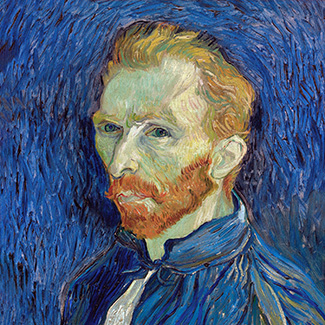
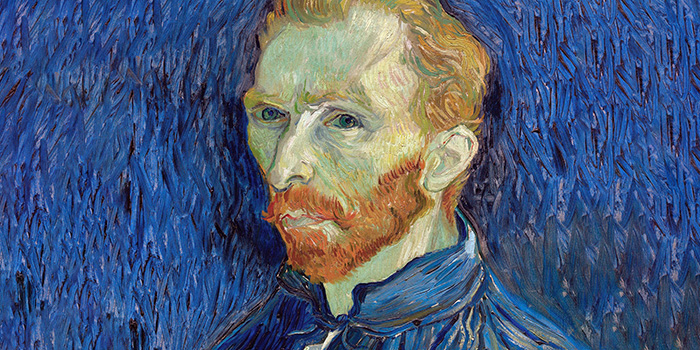
His many self-portraits make it possible to follow changes in both his appearance and his painting style.
Van Gogh also painted landscapes, wheat fields, cypress trees, orchards, cafés, houses, portraits and scenes of everyday life.
A Painting Style That Became Immediately Recognizable
Van Gogh is generally associated with Post-Impressionism. He did not simply try to reproduce faithfully what he saw. He transformed colors, forms and brushstrokes to give his paintings greater intensity.
His works are especially recognizable for:
-
colors that are often very vivid;
-
thick and visible brushstrokes;
-
strong outlines;
-
a pronounced sense of movement in landscapes and skies;
-
an expressive use of color.
His work would strongly influence several 20th-century artists, particularly those associated with Expressionism. That movement also placed great importance on emotion, distortion and intense colors.
Van Gogh was also a highly prolific draftsman. Drawing played an essential role in his artistic training and remained an important part of his work.
The Influence of Japan and Modern Painting
During his stay in Paris, van Gogh discovered Japanese prints, which were then highly popular among European artists. He admired their strong colors, unusual compositions and simplified forms.
He collected Japanese prints with his brother Theo and drew inspiration from them in several works. This influence helped move his painting further away from traditional academic conventions.
Van Gogh also met several important artists of his time. Paul Gauguin came to live with him in Arles for several weeks in 1888. Their relationship was intense and difficult. A severe crisis occurred near the end of their time together, and van Gogh then mutilated part of his left ear.
Fame That Came Mainly After His Death
Van Gogh sold very few works during his lifetime and never experienced the fame later associated with his name. His reputation did, however, begin to grow within artistic circles shortly before his death and continued to increase during the following decades.
His work gained major international recognition in the early 20th century. In 1935, a major retrospective at the Museum of Modern Art in New York helped greatly increase his popularity with the American public.
Van Gogh's paintings are now among the best-known works in major museums around the world, and his name has become almost inseparable from the image of the brilliant artist whose recognition came too late.
Van Gogh in the 19th Century
Van Gogh's lifetime, from 1853 to 1890, overlapped with many major figures in history, literature, science and the arts.
Claude Monet was already active when van Gogh began painting. Auguste Rodin, Paul Cézanne, Edgar Degas, Émile Zola and Pierre-Auguste Renoir also belonged to his era.
Other famous figures help place his life more clearly in historical context:
-
Charles Darwin lived until 1882 and published "On the Origin of Species" in 1859.
-
Louis Pasteur conducted his major research on microbes and vaccines during van Gogh's lifetime.
-
Thomas Edison developed the phonograph in 1877 and played a major role in the development of electric lighting.
-
Gustave Eiffel supervised the construction of the Eiffel Tower, completed in 1889, one year before van Gogh's death.
-
Queen Victoria ruled the United Kingdom throughout van Gogh's entire life.
-
Victor Hugo died in 1885, when van Gogh was 32.
-
Abraham Lincoln was assassinated in 1865, when van Gogh was still a child.
-
Jules Verne published several of his major novels during van Gogh's lifetime.
-
Alexander Graham Bell received a major telephone-related patent in 1876.
-
Sherlock Holmes first appeared in 1887 in a work by Arthur Conan Doyle.
Van Gogh therefore lived in a world already moving rapidly toward modernity: popular photography, the telephone, the phonograph, railways, major international exhibitions and new scientific theories were quickly transforming the society around him.
Quiz questions preview
-
What other activity did Émile Zola pursue during Vincent van Gogh's era?
Architect | Doctor | Composer | Art critic -
What did van Gogh hope to create in Arles by inviting other painters to join him?
An artists' studio | A printing shop | A commercial gallery | A religious school -
What type of institution was van Gogh staying in when he painted "The Starry Night"?
A monastery | A military hospital | A hotel | A psychiatric asylum -
What was Theo's relationship to Vincent van Gogh?
His younger brother | His uncle | His cousin | His brother-in-law -
Which New York museum held a major van Gogh retrospective in 1935?
The Museum of Modern Art | The Whitney Museum | The Guggenheim Museum | The Metropolitan Museum of Art