20th-Century Art
The 20th century was one of the most fertile and disruptive periods in the history of art. Within a few decades, artists challenged perspective, realistic representation, traditional materials and even the definition of an artwork itself. Painting, sculpture, architecture and design were transformed by a rapid succession of experiments, new movements and radical breaks with the past.
The Early Avant-Gardes
At the beginning of the century, several European movements sought to break with 19th-century artistic conventions. Fauvism favored intense, often non-naturalistic colors. Henri Matisse became one of its leading figures, notably through works such as "Woman with a Hat" and "The Dance."
Cubism, developed mainly by Pablo Picasso and Georges Braque around 1907-1908, fragmented forms and presented objects from multiple viewpoints. Picasso’s "Les Demoiselles d’Avignon" marked an important step toward this new approach to space. Cubism also introduced collage into painting.
Expressionism developed especially strongly in Germany and Austria. Artists often distorted bodies, intensified color and used nervous lines to express powerful emotions. Egon Schiele became known for his thin, angular figures, while Wassily Kandinsky gradually pushed painting toward abstraction.
Futurism, launched in Italy in 1909, celebrated speed, machines, automobiles and the energy of modern cities. A few years later, Dada reacted to World War I through absurdity and provocation. Marcel Duchamp profoundly influenced the movement through his readymades, including "Fountain," a urinal presented as an artwork in 1917.
Abstraction, Geometry and New Visual Languages
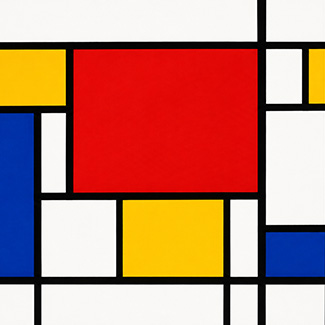
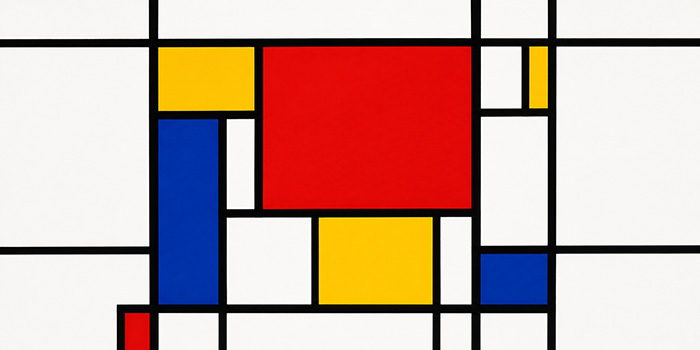
Abstraction became one of the century’s major innovations. Kandinsky was among its pioneers, creating compositions increasingly detached from the visible world. Piet Mondrian developed a visual language based on straight lines, grids and primary colors, particularly within the Dutch movement De Stijl.
In Russia, Kazimir Malevich founded Suprematism, reducing painting to elementary geometric forms. His "Black Square" became an emblem of radical abstraction. Russian Constructivism, meanwhile, connected art with industry, architecture and production.
Founded in Germany in 1919, the Bauhaus brought together fine art, craftsmanship, architecture and design. Paul Klee and Kandinsky both taught there. Klee developed a highly personal style combining geometry, color, fantasy and forms sometimes reminiscent of children’s drawings, as seen in "Senecio" and "Twittering Machine."
Surrealism, Dreams and Imagination
Surrealism took shape in Paris during the 1920s around André Breton. It explored dreams, the unconscious and unexpected associations.
Salvador Dalí became one of its most famous figures, painting impossible scenes with meticulous realism. "The Persistence of Memory," with its melting clocks, remains one of the most recognizable images associated with Surrealism.
René Magritte placed familiar objects in impossible or puzzling situations. "The Son of Man," "The Lovers," "Golconda" and "The Treachery of Images" all play with the relationship between what people see and what they believe they understand.
Marc Chagall created a distinctive world in which people, animals and memories of Vitebsk floated through colorful, poetic scenes. "The Birthday" and "Over the Town" are among his most characteristic works.
Klimt, Art Deco and Decorative Modernity
In Vienna, Gustav Klimt helped found the Vienna Secession in 1897. His Golden Phase combined painting, decorative patterns and gold leaf. "The Kiss" and "Portrait of Adele Bloch-Bauer I" are among his best-known works.
Art Deco flourished mainly during the 1920s and 1930s. It favored geometry, elegance and luxurious materials and influenced painting, furniture, graphic design and architecture. In New York, the Chrysler Building, completed in 1930, became one of its most recognizable architectural symbols.
Antoni Gaudí followed a different path in Barcelona. Associated with Catalan Modernism, he used curves, organic forms and mosaics in works such as the Sagrada Família and Casa Batlló.
American Art After 1945
After World War II, New York became a major center of the art world. Abstract Expressionism developed there with artists such as Jackson Pollock and Mark Rothko.
Pollock popularized drip painting by pouring and flinging paint onto large canvases laid on the floor. Rothko created large compositions made of layered fields of color.
During the 1950s and 1960s, Pop Art drew on advertising, consumer products, celebrities and comic books. Andy Warhol transformed Campbell’s soup cans and Marilyn Monroe into artistic icons. Roy Lichtenstein adapted the visual language of comics, while Robert Indiana created the famous "LOVE" image.
New Forms of Art
Minimalism reduced artworks to simple, repetitive forms, often manufactured from industrial materials. Donald Judd became especially known for series of pared-down geometric structures.
Op Art used contrast and geometric patterns to create optical illusions of movement. Victor Vasarely and Bridget Riley became two of its best-known figures.
Conceptual Art placed the idea behind the artwork above the physical object itself. Land Art took art directly into the landscape and used natural materials. Robert Smithson created "Spiral Jetty" in 1970 on the shore of Utah’s Great Salt Lake.
Toward the end of the century, Jean-Michel Basquiat combined expressive painting with words and symbols, Keith Haring brought simplified figures into public spaces, and Jeff Koons transformed familiar objects into monumental sculptures such as "Balloon Dog."
Major Landmarks of Modern Art
Several institutions became closely associated with 20th- and 21st-century art:
- The Museum of Modern Art, or MoMA, opened in New York in 1929.
- The Centre Pompidou in Paris houses France’s National Museum of Modern Art.
- Tate Modern in London occupies a former power station.
- Madrid’s Reina Sofía Museum displays Picasso’s "Guernica."
- New York’s Guggenheim Museum is famous for its spiral interior ramp.
- The Guggenheim Bilbao, opened in 1997, became a symbol of the city’s cultural renewal.
Quiz questions preview
-
What does Henri Matisse's "The Dance" mainly depict?
Five figures dancing in a circle | A crowd in a street | Bathers beside the water | An orchestra on a stage -
Which Picasso painting shows five women with angular bodies in a strongly distorted space?
Guernica | Les Demoiselles d'Avignon | Three Musicians | La Vie -
Which 1980s movement is Jean-Michel Basquiat generally associated with?
Op Art | Neo-Expressionism | Suprematism | Minimalism -
Who painted "Woman with a Hat"?
Henri Matisse | Maurice de Vlaminck | André Derain | Raoul Dufy -
Which movement celebrated speed, machines and industrial modernity?
Symbolism | Constructivism | Futurism | Surrealism