The French Open
The French Open is one of the four Grand Slam tournaments and the world’s leading clay-court tennis event. Every spring, the best players gather in Paris for a demanding competition marked by long rallies, dramatic comebacks and a history closely tied to the development of French tennis.
From the French Championships to a Grand Slam
The tournament was created in 1891 under the name French Tennis Championships. In its early years, it was restricted to members of French clubs. The first women’s competition was held in 1897.
In 1925, the championship was opened to foreign players. This change allowed it to join the major international competitions already established at Wimbledon and in the United States. The French Championships gradually became one of the four leading tournaments on the world tennis calendar.
The year 1968 marked a decisive turning point. Roland-Garros became the first Grand Slam tournament of the Open Era, during which professional players were allowed to compete against amateurs. The tournament is generally held from late May to early June, after the Australian Open and before Wimbledon.
Why is the tournament called Roland-Garros?
Roland Garros was not a tennis player, but a French aviator. A pioneer of aviation, he completed the first nonstop flight across the Mediterranean Sea in 1913. He was killed in combat in 1918.
In 1927, the French team of René Lacoste, Henri Cochet, Jean Borotra and Jacques Brugnon won the Davis Cup in the United States. To host the return match the following year, France needed to build a suitable venue.
The Stade Français provided a piece of land on the condition that the new stadium be named after Roland Garros, a former member of the club. The stadium opened in 1928 and hosted France’s successful defence of the Davis Cup.
The Musketeers
René Lacoste, Henri Cochet, Jean Borotra and Jacques Brugnon were known as the Four Musketeers. Together, they dominated part of international tennis during the 1920s and 1930s. They notably helped France retain the Davis Cup for six consecutive years, from 1927 to 1932.
The trophy awarded to the men’s singles champion is called the Coupe des Mousquetaires, or Musketeers’ Cup. A plaza within the stadium is also dedicated to them.
The tournament was interrupted during the Second World War. Competitions held during the German occupation are generally not recognized in the official record. Roland-Garros regained its place on the international calendar after the war.
Clay, a demanding surface
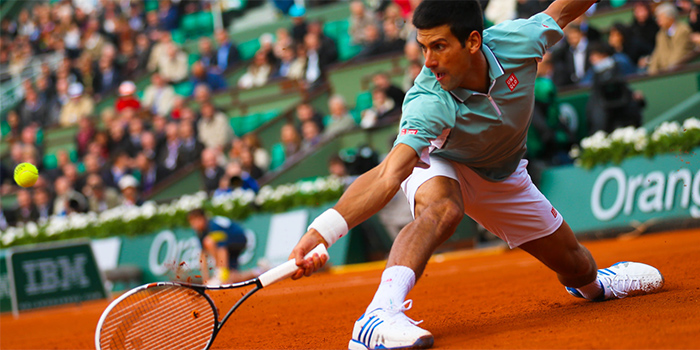
The French Open is the only Grand Slam tournament played on clay. Despite its reddish-orange colour, the surface is not made entirely of soil. It consists of several layers of materials covered with crushed brick.
Clay slows the ball and produces a higher bounce than faster surfaces. It favours long rallies, patience and the careful construction of points. Players must master sliding, defend from well behind the baseline and accept that they may need to hit many shots before finding an opening.
The surface makes matches particularly demanding, both physically and mentally. The serve generally provides less of an advantage than it does on grass or hard courts. Some players excel on clay because of their endurance and heavy groundstrokes, while other great champions have struggled to win in Paris.
The main courts
Court Philippe-Chatrier is the tournament’s centre court. It is named after a former French player and tennis administrator. Rebuilt and modernized, it can accommodate more than 15,000 spectators. A retractable roof now allows matches to continue during rain.
Court Suzanne-Lenglen honours one of the first major stars of women’s tennis. A French champion during the 1910s and 1920s, she helped popularize the sport among a much wider audience.
Court Simonne-Mathieu, opened in 2019, is located in the Jardin des Serres d’Auteuil. Surrounded by greenhouses and vegetation, it is notable for its integration into a historic garden setting.
The great men’s singles champions
Rafael Nadal is inseparable from the history of Roland-Garros. The Spaniard won fourteen titles between 2005 and 2022, a record for any player at a single Grand Slam tournament. His power, topspin, endurance and determination to defend every point earned him the nickname “King of Clay.”
Björn Borg dominated the tournament before him. The Swede won six titles between 1974 and 1981. His calm temperament, physical conditioning and baseline game were perfectly suited to the demands of the surface.
Novak Djokovic managed to defeat Nadal several times at Roland-Garros and completed his career Grand Slam in Paris in 2016. Roger Federer had achieved the same goal in 2009 by winning the only French Open title of his career.
Other major champions include Ivan Lendl, Mats Wilander, Gustavo Kuerten and Guillermo Vilas. Kuerten became especially popular with the crowd because of his playing style, personality and three victories.
The great women’s champions
Chris Evert holds the women’s Open Era record with seven singles titles at Roland-Garros. Her consistency, concentration and outstanding two-handed backhand made her a formidable clay-court opponent.
Steffi Graf won six titles in Paris. In 1988, her French Open victory formed part of her calendar-year Grand Slam, to which she also added an Olympic gold medal. Justine Henin, Monica Seles, Martina Navratilova and Serena Williams also left their mark on the tournament.
Suzanne Lenglen dominated the early decades of women’s tennis. Margaret Court, Arantxa Sánchez Vicario and Iga Świątek later distinguished themselves on the Parisian clay. The women’s tournament has often produced unexpected champions whose strengths were especially well suited to the surface.
Best-of-five matches and marathons
Men’s singles matches are played as best-of-five sets, while women’s matches are played as best-of-three. This difference helps make some men’s encounters particularly long.
Before a final-set tiebreak was introduced, a match could continue until one player gained a two-game advantage. The 2004 match between Fabrice Santoro and Arnaud Clément lasted more than six hours and ended 16–14 in the fifth set.
Matches were also frequently interrupted by rain or darkness. The roof over Court Philippe-Chatrier, lighting on several courts and the introduction of night sessions have reduced some of these interruptions.
Trophies and competitions
The tournament is not limited to men’s and women’s singles. It also includes doubles, mixed doubles, junior competitions and wheelchair tennis events.
The main trophies bear names connected to the history of French tennis.
-
The men’s singles champion receives the Coupe des Mousquetaires.
-
The women’s singles champion receives the Coupe Suzanne-Lenglen.
-
The men’s doubles champions receive the Coupe Jacques-Brugnon.
-
The women’s doubles champions receive the Coupe Simonne-Mathieu.
-
The mixed doubles champions receive the Coupe Marcel-Bernard.
The original trophies remain the property of the tournament. The champions receive replicas.
Traditions and the Parisian atmosphere
The Roland-Garros crowd is known for its enthusiasm, but also for its sometimes severe reactions. Spectators may passionately support a French favourite, adopt a foreign player as one of their own or express their displeasure when they believe a competitor is showing insufficient effort.
The compact courts, the proximity of the spectators and the colour of the clay give the tournament a distinctive visual identity. Straw hats, crowded walkways and matches played in the cool evening air all form part of its atmosphere.
On clay, chair umpires may climb down to inspect the mark left by a ball and determine whether it touched the line. This traditional practice remains characteristic of the surface.
Records and notable facts
-
Rafael Nadal holds the overall record with fourteen men’s singles titles.
-
Chris Evert won seven women’s singles titles during the Open Era.
-
Björn Borg and Steffi Graf each won six singles championships.
-
Roland-Garros became the first Grand Slam tournament of the Open Era in 1968.
-
The tournament is named after an aviator, not a tennis player.
-
The stadium was built so that France could defend the Davis Cup in 1928.
-
Clay slows the ball and favours long rallies.
-
The 2020 tournament was exceptionally moved to the autumn because of the COVID-19 pandemic.
Quiz questions preview
-
Near which park is the Roland-Garros stadium located where the French Open is played?
The Parc de la Vilette | The Luxembourg Gardens | The Champs-Élysées Gardens | The Bois de Boulogne -
Who won the 2018 men's singles against Dominic Thiem?
Novak Djokovic | Juan Martín del Potro | Marin Cilic | Rafael Nadal -
Who won the 2017 men's singles against Stan Wawrinka?
Kevin Anderson | Rafael Nadal | Roger Federer | Andy Murray -
How long was the longest game played without interruption?
7 hours and 21 minutes | 6 hours and 21 minutes | 4 hours and 21 minutes | 5 hours and 41 minutes -
How many balls are usually used in the tournament?
45,000 | 65,000 | 85,000 | 105,000