
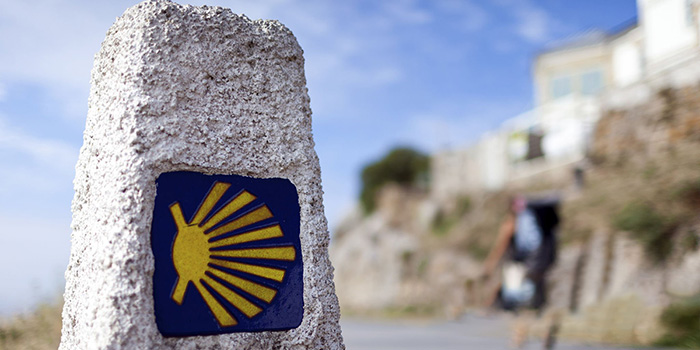
The Ways of St. James
The routes to Santiago de Compostela form a vast network of pilgrimage paths crossing Europe before converging on Santiago de Compostela, in Galicia, northwestern Spain. Travelled since the Middle Ages, they now attract believers as well as hikers seeking silence, encounters or personal achievement. The journey is not defined only by reaching the destination: it takes shape through daily walking, changing landscapes, physical effort, hospitality and the bonds formed among pilgrims.
Saint James and the Origins of the Pilgrimage
-
According to Christian tradition, the apostle James the Greater evangelized part of the Iberian Peninsula.
-
After his martyrdom in Jerusalem, his disciples are said to have transported his body to Galicia.
-
His tomb was supposedly rediscovered in the early 9th century by a hermit guided by a mysterious light.
-
The place was given the name Campus Stellae, commonly interpreted as the “field of the star,” although the exact origin of the name Compostela remains debated.
-
A first church was built on the presumed site of the tomb.
-
The discovery strengthened the religious importance of the Christian Kingdom of Asturias, which was then involved in conflicts with the Muslim powers of the peninsula.
-
The sanctuary gradually became one of the main pilgrimage destinations of medieval Christianity.
A Major Medieval Pilgrimage
-
Santiago de Compostela joined Jerusalem and Rome as one of the principal Christian pilgrimage destinations.
-
Believers from across Europe undertook the journey to pray at the tomb of the apostle.
-
Some sought forgiveness for their sins, the fulfilment of a vow or a cure.
-
Others completed the pilgrimage as a penance imposed by a religious or judicial authority.
-
Pilgrims travelled on foot, on horseback or sometimes by sea.
-
The journey could last several months and expose travellers to hunger, illness, bad weather, thieves and armed conflict.
-
Bridges, hospices, monasteries and churches were built to make their passage easier.
-
The routes therefore contributed to the development of many towns and to the circulation of people, ideas and artistic forms.
The Main Routes
-
There is not one single route to Santiago de Compostela, but several historic paths.
-
The Camino Francés, or French Way, is now the most heavily travelled route.
-
It crosses the Pyrenees before passing through places such as Pamplona, Burgos, León and the plains of Castile.
-
The Camino del Norte follows part of Spain’s northern coast.
-
It offers maritime and mountainous landscapes but often includes steeper terrain.
-
The Camino Primitivo is considered one of the oldest known routes.
-
It connects Asturias with Galicia through a demanding mountain itinerary.
-
The Via de la Plata travels northward from southern Spain, partly following ancient Roman roads.
-
The Camino Portugués usually begins in Lisbon, Porto or other Portuguese cities.
-
The Camino Inglés was used by pilgrims arriving by ship from the British Isles or northern Europe.
The French Routes
-
Several major routes cross France before joining the Spanish paths.
-
The Le Puy route begins in Le Puy-en-Velay and passes through places such as Conques, Cahors and Moissac.
-
The Vézelay route begins near the Basilica of Vézelay in Burgundy.
-
The Tours route passed through cities such as Paris, Tours, Poitiers and Bordeaux.
-
The Arles route crossed southern France before entering Spain through the Somport Pass.
-
These routes do not follow perfectly fixed paths.
-
Medieval pilgrims chose their route according to their starting point, available roads, dangers and the religious places they wished to visit.
-
Today’s routes sometimes use ancient roads, but they also include modern trails developed for hiking.
The Scallop Shell
-
The scallop shell has become the most recognizable symbol of the pilgrimage to Santiago de Compostela.
-
During the Middle Ages, pilgrims often brought back a shell collected near the Galician coast as proof of their journey.
-
It could be attached to a hat, cloak or bag.
-
The lines of the shell converging toward a single point are sometimes interpreted as an image of the many routes leading to one destination.
-
The shell is now used to mark the routes.
-
It appears on signs, stone markers, buildings and objects intended for pilgrims.
-
A yellow arrow also indicates the direction to follow along many Spanish routes.
-
These symbols make navigation easier, although a map or guide remains useful in some regions.
The Pilgrim’s Staff and Clothing
-
The pilgrim’s staff was the traditional walking stick used on the journey.
-
It helped support the walker, cross difficult passages and defend against animals.
-
Medieval pilgrims also carried a small bag containing provisions and personal belongings.
-
Their clothing often included a short cloak and a wide-brimmed hat.
-
Today, walkers generally use a backpack, suitable footwear, lightweight clothing and trekking poles.
-
The weight of the backpack quickly becomes an important concern.
-
Experienced pilgrims usually recommend carrying only what is necessary.
-
Every unnecessary object becomes noticeable after several hours of walking.
The Pilgrim’s Credential
-
The pilgrim’s credential is the traveller’s passport or booklet.
-
It is used to collect stamps throughout the journey.
-
These stamps can be obtained at hostels, churches, cafés, tourist offices and other establishments.
-
The credential records the route travelled and gives access to several accommodations reserved for pilgrims.
-
It also becomes a personal souvenir of the journey.
-
Each stamp recalls a stage, encounter or place visited.
-
Pilgrims must present their credential upon arrival if they wish to request the traditional Compostela certificate.
The Compostela
-
The Compostela is the document awarded to pilgrims who meet certain conditions.
-
It is issued by the Pilgrim’s Office in Santiago de Compostela.
-
A walker must normally have completed at least the final 100 kilometres on foot or horseback.
-
Cyclists must complete a longer minimum distance.
-
Pilgrims must have their credential stamped regularly to demonstrate their route.
-
The Compostela is traditionally associated with a religious or spiritual motivation.
-
Other certificates may be awarded to people who mainly completed the route for cultural or athletic reasons.
-
The certificate offers symbolic recognition, but it does not summarize the entire experience.
Pilgrim Hostels
-
Accommodations intended for pilgrims are generally called albergues in Spain.
-
They may be operated by municipalities, associations, religious communities or private owners.
-
Facilities are often simple and include dormitories, showers and sometimes a kitchen.
-
Some establishments are run with the help of volunteers known as hospitaleros.
-
Hospitality occupies a central place in the traditions of the routes.
-
Shared meals and dormitories encourage encounters between people of different nationalities.
-
Comfort varies greatly from one place to another.
-
Snoring, early departures and a lack of privacy are also part of the collective experience.
A Day of Walking
-
Pilgrims often begin their day early to avoid the heat and reach the next stop before late afternoon.
-
The daily distance depends on physical condition, terrain and available time.
-
Many walkers cover between 15 and 30 kilometres per day.
-
The stages are not compulsory, and each person can adjust the pace.
-
The day is broken up by rests, simple meals and passages through villages.
-
Some pilgrims walk alone, while others form temporary groups.
-
Bonds develop quickly, but companions may later separate according to their pace or itinerary.
-
The route often teaches walkers to accept the unexpected and revise their plans.
Physical Difficulties
-
Repeated walking over several days puts strain on the feet, knees, hips and back.
-
Blisters are among the most common problems.
-
Poor footwear or an overly heavy backpack can turn minor discomfort into a serious injury.
-
Heat, cold, rain and wind make some stages more difficult.
-
Long descents can be as demanding as climbs.
-
Hydration, food and rest are essential.
-
It is better to shorten a stage or stop than to worsen an injury.
-
The route is not a competition, even though some walkers set demanding goals for themselves.
A Spiritual and Personal Journey
-
Many pilgrims undertake the route for religious reasons.
-
They may attend Mass, pray in churches or meditate while walking.
-
Others seek a period of reflection after bereavement, separation, illness or a major life change.
-
The repetition of footsteps and the simplicity of daily life encourage introspection.
-
Pilgrims often have to give up part of their comfort, habits and distractions.
-
This simplicity can change their relationship with time and material needs.
-
Some people find answers, while others return with new questions.
-
The journey can be deeply meaningful without necessarily producing a dramatic revelation.
Encounters Along the Way
-
The routes attract people of all ages and from many countries.
-
Conversations often begin with simple questions about the starting point, destination or condition of one’s feet.
-
Language differences are sometimes overcome through a few words, gestures or mutual assistance.
-
Pilgrims share advice, food, medicine or equipment.
-
A particular sense of solidarity develops among people who did not know one another only a few hours earlier.
-
Some friendships last only a few stages, while others continue long after the journey.
-
Residents of the villages also contribute to the experience through their hospitality and services.
An Architectural Heritage
-
The routes pass through regions rich in churches, monasteries, bridges and ancient towns.
-
Romanesque art is particularly present along several medieval paths.
-
Religious buildings welcomed pilgrims and presented them with biblical stories through sculpture and painting.
-
The Basilica of Sainte-Marie-Madeleine in Vézelay, the Abbey Church of Conques and the Basilica of Saint-Sernin in Toulouse are among the major monuments associated with the French routes.
-
In Spain, Burgos Cathedral, the monastery of San Juan de Ortega and the city of León are important landmarks on the Camino Francés.
-
Medieval bridges reflect the efforts made to provide safer passage for travellers.
-
The heritage of the routes also includes modest chapels, crosses, fountains and milestones.
Nature and Landscapes
-
The routes cross highly varied environments.
-
Pilgrims may cross the Pyrenees, walk along the ocean, pass through vineyards or travel across the broad plateaus of Castile.
-
The Spanish Meseta is known for its long straight roads, open plains and limited shade.
-
Galicia offers greener landscapes, forests, hills and frequent rain.
-
Prolonged contact with nature forms an important part of the journey.
-
Changes in light, temperature and vegetation give each stage a distinct atmosphere.
-
The landscapes also impose their own rhythm and remind walkers of the limits of their bodies.
Santiago de Compostela Cathedral
-
The cathedral stands on the site associated with the tomb of the apostle James.
-
Its construction began in the 11th century.
-
The building is mainly Romanesque, with later Gothic, Renaissance and Baroque additions.
-
Its Obradoiro façade is one of the city’s most famous images.
-
The Portico of Glory is a medieval sculptural ensemble depicting Christ, the apostles and biblical figures.
-
Pilgrims can visit the crypt where the relics attributed to Saint James are kept.
-
Arriving in the square in front of the cathedral often produces strong emotions after several weeks of walking.
The Botafumeiro
-
The Botafumeiro is a huge incense burner used during certain ceremonies in the cathedral.
-
It is suspended beneath the vault by a system of ropes.
-
Several men set it in motion so that it swings through the transept at high speed.
-
Its use has a liturgical function and also helped perfume the church when it was crowded with pilgrims.
-
Its spectacular movement has become one of the cathedral’s best-known symbols.
-
It is not used at every Mass.
-
Pilgrims are therefore not guaranteed to see it in motion when they arrive.
Cape Finisterre
-
Some walkers continue their journey after Santiago de Compostela.
-
They travel to Cape Finisterre on Galicia’s Atlantic coast.
-
Its name comes from the Latin Finis Terrae, meaning “end of the earth.”
-
In antiquity, the region was seen as the western edge of the known world.
-
Other pilgrims continue to the sanctuary of Muxía.
-
This extension adds several days of walking.
-
It allows travellers to end the journey facing the ocean, in a very different setting from the cathedral.
The Modern Revival
-
Use of the routes declined sharply during certain periods of history.
-
Their popularity began to grow again during the 20th century.
-
Trail markers, monument restoration and the creation of accommodations made it easier for walkers to return.
-
Travel accounts, films and personal testimonies also helped make the experience better known.
-
The routes now attract hundreds of thousands of people in some years.
-
This popularity supports the economy of many villages but also creates overcrowding.
-
The sections near Santiago are especially busy during the high season.
-
Some pilgrims therefore seek less familiar routes or choose to travel in spring or autumn.
Current Challenges
-
The success of the routes can transform villages and place greater pressure on accommodations and services.
-
Some paths risk losing their peaceful character when visitor numbers become too high.
-
Waste, trail erosion and the behaviour of some visitors can harm the places crossed.
-
The commercialization of the pilgrimage has also drawn criticism.
-
Shops, baggage transport services and tourist packages are now common along many routes.
-
These services make the journey more accessible, but they sometimes alter the traditional experience.
-
Each pilgrim must therefore find a balance between comfort, effort, safety and the meaning they wish to give to the journey.
Quiz questions preview
-
In which country is Santiago de Compostela located?
Italy | Spain | Portugal | France -
Which French way passes through the cities of Le Puy-en-Velay and Conques?
Via Tolosana | Via de la Plata | Via Turonensis | Via Podiensis -
In addition to the yellow arrows, what other sign indicates the direction to follow on the various ways?
A white cross on a red background | A green circle | A blue arrow | A yellow shell on a blue background -
Which religious artifact attracts believers to Santiago de Compostela?
The shrine of the relics of Saint James | The tomb of the apostle James | The golden cross of the evangelist James | The Shroud of Saint James -
Which French way should you take from Paris to Santiago de Compostela?
Arles Way (Via Tolosana) | Tours route (Via Turonensis) | Vézelay route (Via Lemovicensis) | Le Puy route (Via Podiensis)