
Mystical Places
Since prehistoric times, humans have associated certain places with the presence of the sacred, ancestors, or invisible forces. Mountains, caves, temples, tombs, and holy cities have become spaces for prayer, pilgrimage, or meditation. Their power comes as much from their history as from the stories, rituals, and beliefs surrounding them.
Sacred Natural Landscapes
Long before temples were built, entire landscapes were considered sacred.
Mount Kailash, in Tibet, is revered by several religious traditions, including Hinduism and Buddhism. Pilgrims walk around it, but its summit is not officially climbed out of respect for its sacred character.
In Japan, Mount Fuji is associated with Shinto and Buddhist beliefs. In Australia, Uluru holds a central place in the traditions of the Anangu people, who connect its rock formations to ancestral stories.
Caves may represent an entrance to the underworld, a place of revelation, or a space for retreat. Some have housed hermits, sanctuaries, or ritual paintings.
Temples of the Ancient World
The great civilizations built temples to honour their deities and organize religious ceremonies. These structures were often aligned according to the stars, the surrounding landscape, or precise symbolic rules.
At Karnak, in Egypt, a vast complex of temples was mainly dedicated to the god Amun.
Delphi, in Greece, was considered the centre of the world in antiquity. Visitors travelled there to consult the oracle of Apollo, whose answers were delivered by a priestess known as the Pythia.
In the Andes, Machu Picchu retains a mysterious aura because of its isolation and its still-debated purpose. The Inca city contains ceremonial spaces connected to the Sun, the mountains, and agricultural cycles.
Megaliths and Mysterious Monuments
Megalithic monuments are often associated with the stars, the dead, or communal rituals. Their exact purpose sometimes remains uncertain, which has encouraged many legends.
Stonehenge, in England, consists of massive stones arranged in circles. Its alignment with the solstices reveals knowledge of celestial cycles.
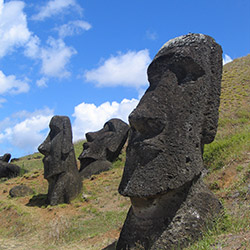
The Carnac alignments, in Brittany, contain thousands of standing stones. Their meaning remains unknown. On Easter Island, the moai probably represent important ancestors and express a connection between communities, the dead, and the land.
Great Holy Cities
Some cities are sacred because they are connected to the birth of a religion, the life of a prophet, or foundational events.
Jerusalem is holy to Judaism, Christianity, and Islam. It contains the Western Wall, the Church of the Holy Sepulchre, and the Dome of the Rock.
Mecca is the holiest city in Islam. The Kaaba, located at the centre of the Grand Mosque, is the point toward which Muslims face during prayer.
Varanasi, on the banks of the Ganges, is one of Hinduism’s holiest cities. Pilgrims bathe there, pray, and attend funeral ceremonies. Dying or being cremated in Varanasi is traditionally associated with liberation from the cycle of rebirth.
Shrines and Pilgrimage Sites
A pilgrimage involves travelling to a sacred place to pray, fulfil a religious duty, or transform one’s inner life.
Santiago de Compostela, in Spain, has attracted pilgrims since the Middle Ages along several walking routes. Lourdes, in France, became a major Catholic pilgrimage centre after the Marian apparitions reported by Bernadette Soubirous in 1858.
Bodh Gaya, in India, marks the place where Siddhartha Gautama is believed to have attained Enlightenment beneath a tree. The Mahabodhi Temple makes it one of Buddhism’s main pilgrimage sites.
The Great Temples of Asia
Angkor Wat, in Cambodia, was first built as a Hindu temple before becoming an important Buddhist site. Its towers symbolically represent Mount Meru, the mountain at the centre of the universe in Hindu cosmology.
Borobudur, in Indonesia, is an immense Buddhist monument made up of several levels of terraces. The ascent toward the summit represents a spiritual journey toward Enlightenment.
The Golden Temple, in Amritsar, is the principal shrine of Sikhism. Surrounded by water, it can be entered through several gateways, symbolizing openness to everyone.
Tombs and Funerary Spaces
Places associated with the dead often take on a mystical character because they connect the visible world with ancestors or the afterlife.
The Pyramids of Giza were built as royal tombs. Their size, precision, and age have inspired many theories, but they belong first and foremost to ancient Egyptian beliefs about the pharaoh’s survival after death.
The Valley of the Kings contains the tombs of several rulers of the New Kingdom.
The Taj Mahal, in India, is a mausoleum built by Emperor Shah Jahan in memory of his wife Mumtaz Mahal. Its architecture also evokes paradise in the Islamic tradition.
Myths, Legends, and Modern Perceptions
Some places owe part of their fame to stories that are difficult to verify. The Bermuda Triangle is associated with the disappearance of ships and aircraft, although many cases have ordinary explanations.
Mount Shasta, in California, is surrounded by Indigenous stories, modern spiritual beliefs, and legends about hidden civilizations. Glastonbury, in England, is connected to King Arthur, the Holy Grail, and early British Christian traditions.
Mysticism therefore does not always depend on an organized religion. An impressive landscape, ancient ruins, or a story passed down through generations may be enough to give a place a sacred dimension.
Quiz questions preview
-
This type of Egyptian funerary building, such as the one at Nagada, served as a royal burial place before the first pyramids.
Sarcophagus | Tumulus | Mausoleum | Mastaba -
This church, venerated by Christians, is said to have been built, according to tradition, on the site of the tomb of Jesus.
St. Sophia's Church | The Church of the Annunciation | The Church of the Holy Sepulchre | The Church of the Temple -
These Orthodox Christian monasteries were erected atop cliffs and rocky peaks in the plain of Thessaly.
The Asclepios monasteries | The Silos monasteries | The Meteora monasteries | The Montserrat monasteries -
Mountain associated with the Cave of Elijah, a sacred place for Jews, Christians, Muslims and Druze.
Mount Carmel | Mount Thabor | Mount Lebanon | Mount Hermon -
In Greek mythology, this city was chosen by Zeus to become a place of sporting competition between the gods.
Marathon | Olympia | Decalogue | Delphi