
Illustrated characters
Illustrated characters hold a special place in the collective imagination. They emerge from the meeting of text, artwork, and a recognizable personality. Whether they come from a children’s book, a novel, a newspaper, or a comic, their appearance contributes as much as their adventures to their fame.
When Images Bring Characters to Life
An illustrated character is not defined only by a name or a story. Their silhouette, clothing, colours, and expressions all contribute directly to their identity.
The artwork can emphasize courage, innocence, cleverness, or clumsiness. A few elements are sometimes enough to make a figure instantly recognizable, such as a cape, a hat, a hairstyle, or a particular object.
Unlike a character in an unillustrated novel, whose appearance each reader imagines freely, an illustrated character often has a shared visual representation. This image can become almost as important as the original text.
Illustrated Literature
Long before the rise of comics, illustrated books gave many characters a lasting appearance.
The Little Prince, created by Antoine de Saint-Exupéry, is inseparable from his tunic, scarf, and golden hair. The author’s watercolours extend the poetry of the story and contribute greatly to the character’s identity.
Alice, in Alice’s Adventures in Wonderland, is strongly associated with John Tenniel’s illustrations. Other artists have portrayed her since then, but the earliest editions had a profound influence on popular culture.
Winnie-the-Pooh, Peter Rabbit, Babar, and the Moomins also show how images can transform literary characters into universal figures.
Adventurers and Comic-Book Heroes
Comics combine text and images directly through a sequence of panels. Characters are defined as much by their words as by their movements.
Tintin is recognizable by his quiff, plus fours, and faithful companion Snowy. His appearance changes very little, even though his adventures take him into many different settings.
Asterix and Obelix are based on a strong visual contrast. The first is small, quick, and clever; the second is enormous, powerful, and spontaneous. Their complementary personalities make the pair immediately understandable.
Lucky Luke, Corto Maltese, and other adventure heroes also have clear silhouettes suited to their respective worlds.
Superheroes
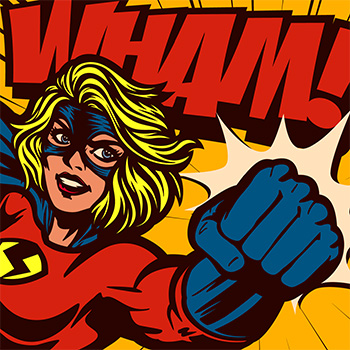
Superheroes are among the most famous illustrated characters. Their costumes turn their identities into symbols.
Superman is associated with a cape, bright colours, and an emblem worn on his chest. Batman instead uses a dark silhouette and imagery inspired by the bat.
Spider-Man is distinguished by his mask, web pattern, and acrobatic movements. Wonder Woman combines strength with iconic accessories such as the Lasso of Truth.
These characters evolve over the decades. Their costumes, powers, and personalities are adapted to social changes, new audiences, and the artists who continue their adventures.
Humour and Social Criticism
Illustrated characters can also be used to observe society through humour.
Charlie Brown, Snoopy, and the other characters from Peanuts explore childhood, failure, friendship, and anxiety with apparent simplicity. The minimalist artwork contrasts with the depth of their reflections.
Mafalda questions adults, politics, and the world’s injustices. Her perspective as a child allows for criticism that is both accessible and sharp.
Garfield, Gaston Lagaffe, and Calvin and Hobbes use everyday situations to reveal laziness, imagination, absurdity, and the frustrations of modern life.
A Strong Visual Identity
The success of an illustrated character often depends on the clarity of their design.
A simple shape makes recognition easier. Consistent colours, a particular posture, and a few accessories create a stable visual identity.
The drawing style also influences how the character is perceived. Rounded lines can suggest gentleness or humour, while sharper angles may express tension or danger.
Facial expressions also play an essential role. A glance or movement can replace several sentences and communicate an emotion immediately.
Characters That Evolve
Even when their appearance seems unchanged, illustrated characters evolve with their time.
Authors sometimes modify their language, behaviour, or surroundings. Certain older portrayals are also reassessed when they convey stereotypes that have become unacceptable.
A character may pass through the hands of several artists and writers. Each one preserves fundamental elements while adding a personal interpretation.
This evolution allows major figures to remain relevant, but it can also cause debate among readers who are attached to a particular version.
From Books to Other Media
Illustrated characters often leave the printed page and move into cinema, television, video games, or merchandise.
An adaptation transforms a static drawing into a voice, movement, and sometimes a live-action figure. Certain details are preserved so that audiences can recognize the original character immediately.
Moving into other media can greatly increase a character’s fame. However, it may also alter their personality, appearance, or story to meet the needs of a new format.
Quiz questions preview
-
This green giant represents the duality between the human intellect and the uncontrollable brute.
Jolly Green | Beast | Hulk | Swamp Thing -
This shy, often unlucky character, created by Charles Schulz, first appeared on October 2, 1950.
Calvin | Donald Duck | Charlie Brown | Garfield -
Which superhero is mainly dressed in blue in the comics?
Iron Man | Black Widow | Flash | Superman -
Which Belgian comic strip, created in 1968 by writer Raoul Cauvin, is set during the American Civil War?
The Blue Soldiers | The Blue Adventurers | The Blue Knights | The Bluecoats -
Who first appeared in the “Steamboat Willie” cartoon on November 18, 1928?
Mandrake | Mickey Mouse | Oswald | Popeye