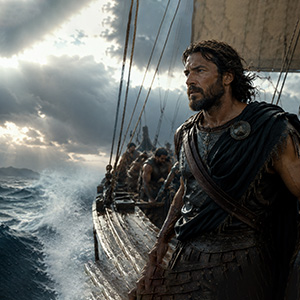
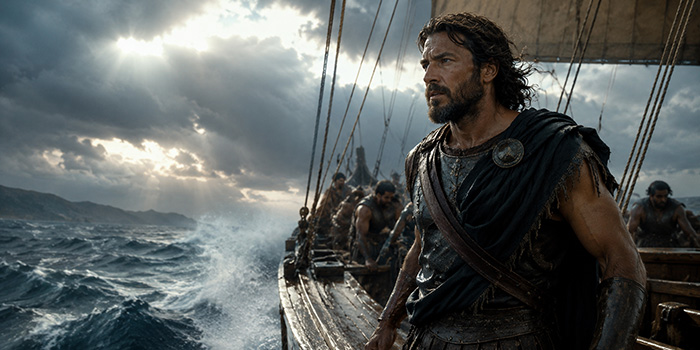
Homer’s Odyssey
Probably composed toward the end of the eighth century BCE and attributed to Homer, “The Odyssey” is one of the foundational works of Western literature. It tells the story of Odysseus’s difficult return to his kingdom of Ithaca after the Trojan War. Behind the monsters, storms, and divine interventions lies above all a reflection on homecoming, identity, loyalty, and human intelligence in the face of an unpredictable world.
An Epic Built Around the Return Home
“The Odyssey” belongs to the tradition of Greek epic poetry, like “The Iliad,” also attributed to Homer. The two works, however, have very different centres of gravity. “The Iliad” takes place during the Trojan War and focuses above all on the anger of Achilles, martial glory, and death. “The Odyssey” begins after the fall of Troy and centres on the “nostos,” the hero’s return to his homeland.
Odysseus has been away from Ithaca for nearly twenty years: about ten years spent fighting at Troy and another ten trying to return home. Yet the poem does not begin with his departure from Troy. It opens when Odysseus has already been held for years on Calypso’s island. His earlier adventures are told later by the hero himself to the Phaeacians. This non-chronological structure makes Odysseus not only the central character of the story, but also one of its narrators.
The work is divided into 24 books. The opening books focus largely on Telemachus and the situation in Ithaca; they are followed by Odysseus’s account of his travels, then by his return and confrontation with the suitors.
Odysseus, a Hero of Cunning
Odysseus differs from the great warriors of epic tradition in the nature of his heroism. He knows how to fight, but his essential quality is “metis,” a practical intelligence based on cunning, adaptability, and the ability to recognize the right moment to act. Tradition also credits him with the idea of the Trojan Horse, which allowed the Greeks to enter the city after ten years of siege.
This intelligence enables him to survive situations in which strength would be useless. Odysseus knows how to lie, conceal his identity, invent stories, and manipulate his opponents. These qualities, however, have a darker side: his pride and desire for recognition sometimes bring him new misfortunes. The episode with Polyphemus provides the clearest example.
Ithaca Without Its King
During Odysseus’s absence, his kingdom falls into disorder. Nobles from Ithaca and the surrounding islands have settled in his palace and are courting Penelope, convinced that her husband is dead. They consume his supplies, slaughter his livestock, and exploit the hospitality of the household without restraint. Their behaviour represents a serious violation of the social and religious rules governing the treatment of guests in the Greek world.
Penelope nevertheless refuses to choose a new husband. She gains time by announcing that she will remarry once she has finished weaving a burial shroud for her father-in-law, Laertes. For several years, she secretly undoes each night what she has woven during the day. Her cunning therefore mirrors that of her husband: if Odysseus survives through intelligence, Penelope preserves their household through hers.
Telemachus Comes of Age
The opening books follow Telemachus, still too young to impose his authority on the suitors. Athena, Odysseus’s divine protector, encourages him to leave Ithaca in search of news about his father. He travels to see Nestor at Pylos and Menelaus at Sparta, both former companions of Odysseus during the Trojan War.
This part of the story is also a process of education. Telemachus discovers the wider world, learns to speak before older men, and begins to assume his status as the king’s son. His development prepares him for the moment when he can finally act alongside Odysseus against those who have occupied their home.
Calypso and the Desire to Return
When the story turns to Odysseus, he is on the island of the nymph Calypso, who has kept him with her for seven years. She wants him to remain and even offers him immortality. Odysseus, however, prefers to return to a human life, limited and mortal, with Penelope and in his own kingdom.
The gods finally decide that he must be released. Hermes delivers Zeus’s order to Calypso, and Odysseus builds a raft. Poseidon, who is hostile to him, sends a storm that destroys his vessel. The hero eventually reaches the land of the Phaeacians, where the princess Nausicaa helps him. Welcomed at the court of King Alcinous, he reveals his identity and begins to recount the trials that brought him there.
Polyphemus and the Anger of Poseidon
Among these adventures, the encounter with the Cyclops Polyphemus is the most famous. Odysseus and several of his men enter a cave filled with provisions and wait for its owner to return. Polyphemus, a gigantic one-eyed Cyclops, refuses the laws of hospitality, traps the Greeks, and begins devouring them.
Odysseus cannot simply kill him, because only the Cyclops is strong enough to move the rock blocking the entrance. He therefore gets Polyphemus drunk and tells him that his name is “Nobody.” Once the Cyclops falls asleep, the Greeks blind him with a sharpened stake. When the other Cyclopes hear his cries and ask who is attacking him, he replies that “Nobody” is hurting him, convincing them not to intervene. Odysseus and his companions then escape by tying themselves beneath the Cyclops’s sheep.
But Odysseus cannot resist the desire for glory. Once safely at sea, he reveals his true name to Polyphemus. The Cyclops is the son of Poseidon and asks his father to punish the hero. Odysseus’s pride thus turns a victory achieved through intelligence into the source of further suffering.
Companions Who Endanger the Journey
Odysseus suffers not only because of hostile gods. Several disasters are caused by the recklessness of his own companions. Aeolus, keeper of the winds, gives him a bag in which all the contrary winds have been imprisoned. When Ithaca is almost in sight, the sailors, convinced that their leader is hiding treasure from them, open the bag while he sleeps. The winds burst free and drive the ship far away from its destination.
Later, the Laestrygonians, a race of cannibalistic giants, destroy almost the entire fleet. Only one ship survives. From that point onward, the journey becomes the story of an ever-diminishing group until Odysseus is finally left alone.
Circe and the World of the Dead
The island of Circe marks another decisive stage. The sorceress transforms several of Odysseus’s companions into pigs, but Hermes gives the hero the means to resist her spell. Odysseus forces Circe to restore his men to human form and then becomes her guest. The travellers remain on the island for about a year before continuing their journey.
Circe tells them, however, that Odysseus must first consult the prophet Tiresias in the land of the dead. In this realm at the edge of the world, the hero encounters not only Tiresias, who warns him about future dangers, but also the shade of his mother Anticlea, whose death he had not known about. He also meets several heroes from Troy, including Agamemnon and Achilles. The encounter with the dead gives the journey a new depth: Odysseus is now confronted with the consequences of his long absence from Ithaca and with the human cost of war.
The Sirens, Scylla, and Charybdis
Following Circe’s advice, Odysseus prepares to face the Sirens, whose song irresistibly draws sailors toward death. He still wants to hear them. He therefore plugs his companions’ ears with wax and orders them to tie him to the mast. When the Sirens begin to sing, Odysseus begs to be released, but his men follow his earlier instructions and continue sailing. Once again, the episode presents a hero who understands his own weakness and is capable of devising a way to control it.
The passage between Scylla and Charybdis then forces an even harsher choice. Charybdis is a whirlpool capable of swallowing an entire ship, while Scylla is a monster that seizes sailors who pass within reach. Odysseus chooses to sail closer to Scylla and loses six men in order to save the rest of the crew. This time there is no perfect solution: leadership means choosing between two dangers.
The Cattle of Helios
Tiresias and Circe have warned Odysseus never to harm the sacred cattle of the sun god Helios. When the travellers are trapped by bad weather on the island where the animals graze, hunger eventually overcomes the companions’ obedience. While Odysseus sleeps, they slaughter several of the cattle.
Helios demands punishment, and Zeus destroys their ship when they return to sea. All of Odysseus’s companions die in the storm. The hero, now the sole survivor, drifts to Calypso’s island. His account has therefore caught up with the point at which the action stood at the beginning of the epic.
The Return to Ithaca
After hearing his story, the Phaeacians finally take Odysseus back to Ithaca. But the hero does not immediately reclaim his place as king. Athena alters his appearance so that he resembles an old beggar, allowing him to observe the situation without being recognized and to distinguish those who have remained loyal from those who have betrayed him.
He first finds shelter with Eumaeus, the swineherd who has remained faithful to his master. Telemachus returns shortly afterward from his journey, and Odysseus reveals his true identity to him. Father and son can now prepare together to eliminate the suitors.
The return also contains one of the most moving episodes in the poem. Argos, Odysseus’s old dog, recognizes his master despite the disguise. Neglected and weakened, he dies moments after seeing him again, as though he had waited all those years for his return.
Odysseus’s Bow and the Revenge
Penelope eventually announces a contest to decide among the suitors. The man who can string Odysseus’s bow and shoot an arrow through twelve axe heads will be able to marry her. None of the suitors can even string the weapon.
The beggar then asks to take part. Odysseus handles the bow easily, completes the shot, and reveals his identity. With Telemachus and a few loyal servants, he then attacks the suitors. The scene represents a violent restoration of order: those who have plundered his household and violated the laws of hospitality are destroyed.
Penelope Tests Odysseus
Even after the victory, Penelope refuses to immediately recognize the man claiming to be her husband. She sets a trap of her own by ordering that their marriage bed be moved.
Odysseus reacts at once because he knows that the bed cannot be moved: he built it himself around the trunk of an olive tree still rooted in the ground. This secret is known only to the two of them. Penelope finally has the proof she has been waiting for, and their reunion brings twenty years of separation to an end.
Homecoming, Identity, and Hospitality
Odysseus’s voyage is above all a quest for home. He refuses the immortality offered by Calypso because he wants to return to a specific place, a family, and an identity. Ithaca is not presented as the richest or most magnificent kingdom in the world; its value comes from the fact that it is his homeland. Returning therefore means much more than reaching a geographical destination: it means becoming husband, father, and king again.
Identity is also a constant theme. Odysseus often survives by hiding his name or inventing false stories, yet he also longs to be recognized. The tension between concealment and recognition runs throughout the work, from the “Nobody” used against Polyphemus to the secret of the marriage bed that finally allows Penelope to identify him.
Finally, “The Odyssey” gives enormous importance to hospitality. The Phaeacians, Eumaeus, and several other characters welcome strangers with respect, while Polyphemus and the suitors violate this sacred obligation. The way a character treats someone who arrives at the door becomes almost a measure of moral worth.
Through this combination of extraordinary adventures and deeply human questions, “The Odyssey” goes far beyond the story of a man lost at sea. It tells of the desire to recover one’s place after a long absence and presents intelligence, patience, and loyalty as forms of heroism just as important as physical strength.
Quiz questions preview
-
Which Phaeacian king was Nausicaa’s father?
Nestor | Menelaus | Priam | Alcinous -
In the form of which friend of Odysseus did Athena accompany Telemachus to Pylos?
Mentes | Pisistratus | Nestor | Mentor -
On which island did Odysseus wash ashore after Zeus destroyed his ship off Thrinacia?
Ogygia | Ithaca | Scheria | Aeaea -
What was a poet-singer called in ancient Greece?
An aoidoi | A rhapsode | A bard | A hoplite -
Which aoidos sang at King Alcinous’s court during Odysseus’s stay?
Demodocus | Elpenor | Tiresias | Eumaeus