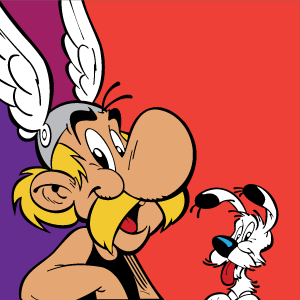

Asterix, the Most Famous Gaul
Asterix is one of the most famous works in Franco-Belgian comics. Beneath the appearance of humorous adventures set in ancient Gaul, the series offers a rich world filled with characters, wordplay, and cultural references. Its success rests as much on its humour as on its ability to appeal to several generations of readers.
The Birth of an Indomitable Village
Asterix was created in 1959 by writer René Goscinny and illustrator Albert Uderzo. The series first appeared in the magazine “Pilote,” founded that same year. At a time when many comic-book heroes experienced adventures in distant lands, the two creators chose to build a world inspired by the history of France.
The story takes place around 50 BCE, after Julius Caesar’s conquest of Gaul. One small village in Armorica continues to resist Roman occupation thanks to a magic potion that grants superhuman strength. This deliberately simplified historical setting allows the creators to develop comic adventures without attempting a perfectly accurate reconstruction of antiquity.
Asterix does not therefore claim to tell the true history of the Gauls. Instead, the series uses the past as a distorted mirror of the modern world. Contemporary institutions, behaviours, and conflicts are transposed into an ancient setting.
Two Complementary Heroes
Asterix is a small warrior who is intelligent, brave, and resourceful. He does not rely solely on the magic potion to solve problems. His powers of observation, calm nature, and ability to understand his opponents are his greatest strengths.
Obelix, his best friend, has an almost opposite personality. Large, powerful, impulsive, and deeply likeable, he fell into the magic potion as a child. As a result, he possesses permanent strength and is normally forbidden from drinking any more. This restriction becomes one of the series’ main sources of comedy.
The two characters form an effective pair because their qualities complement each other. Asterix thinks before acting, while Obelix often prefers to solve problems directly. Despite their arguments, their friendship remains strong. They share a taste for adventure, loyalty to their village, and a deep attachment to freedom.
Obelix is almost always accompanied by Dogmatix, a small dog who is especially sensitive to the destruction of trees. His presence adds another layer of humour and sometimes helps move the story forward.
A Community Filled with Memorable Characters
The Gaulish village is much more than a simple backdrop. It represents a small society in which everyone has a role, a personality, and easily recognizable flaws.
Vitalstatistix, the village chief, tries to preserve his authority despite the difficulties faced by the warriors carrying him on his shield. He is courageous, but remains troubled by one true fear: that the sky may fall on his head.
Getafix, the druid, prepares the magic potion and represents the wisdom of the village. He knows plants, understands different remedies, and generally tries to calm conflicts. His knowledge earns him respect, even from some enemies.
Cacofonix, the bard, is convinced that he possesses great musical talent, unlike most of the villagers. His songs regularly provoke the anger of his neighbours. Unhygienix, the fishmonger, and Fulliautomatix, the blacksmith, frequently argue over the freshness of the fish. Geriatrix, the village elder, refuses to consider himself too old to take part in village activities.
These disputes show that the Gauls are not a perfectly united community. They often quarrel over trivial matters, but immediately come together when faced with an outside threat.
Humour as the Series’ Greatest Strength
The humour in Asterix works on several levels. Younger readers can enjoy the fights, falls, chases, and exaggerated reactions of the characters. Adults are more likely to recognize the political, historical, literary, and social references woven into the dialogue and situations.
Wordplay plays an essential role. The names of the Gauls generally end in “-ix,” those of the Romans in “-us,” while the names of other peoples often follow rules adapted to their origins. These constructions make it possible to create names that sometimes summarize a character’s occupation or personality.
The creators also make use of anachronisms. The characters adopt modern habits, speak like contemporary people, and encounter ancient versions of things that appeared much later. Travel often serves as a way to parody traits associated with different regions or nations.
Visual humour complements the dialogue. Roman soldiers flying through the air, dented helmets, destroyed camps, and exaggerated facial expressions create comedy that is immediately understandable. The fights are spectacular, but generally have no serious consequences.
The Romans and Authority
The Romans represent the occupying power and the imperial administration. They have an organized army, roads, fortified camps, and a complex hierarchy. Yet this power is often incapable of defeating a small and disorderly community.
The legionaries are not all portrayed as cruel or threatening. Many seem tired, clumsy, or discouraged by the orders they receive. Officers sometimes try to advance through the ranks, while ordinary soldiers mainly attempt to avoid being beaten.
Julius Caesar occupies a special position. He can be authoritarian, proud, and calculating, but he generally retains a certain dignity. He sometimes recognizes the worth of his opponents and respects commitments he has made. The series presents him less as a simple villain than as a powerful ruler constantly frustrated by a village that cannot be subdued.
Resistance and Freedom
The main theme of Asterix remains resistance to a dominant power. The villagers refuse to surrender their independence, customs, and way of life. Their victories depend on the magic potion, but also on their solidarity and refusal to be intimidated.
This resistance should not be understood as an accurate representation of historical Gaul. It corresponds more closely to a humorous view of the French spirit, with its attachment to freedom, debate, and resistance to authority.
The series also shows that this independence has a less flattering side. The Gauls are argumentative, proud, and sometimes unable to agree with one another. Their disorder contrasts with Roman discipline. This opposition allows the creators to mock both the conquerors and those who resist them.
Travel and Encounters with Other Peoples
Although the village remains at the heart of the series, Asterix and Obelix regularly travel abroad. These journeys expand the settings and confront the heroes with different customs. Each people is presented through habits, expressions, clothing, or behaviours that are easily recognizable.
These portrayals often rely on national caricatures. Their main purpose is generally to produce comedy rather than accurately describe a population. Some stereotypes reflect the period in which the stories were written and may now seem simplistic.
The journeys mainly serve as a reminder that cultural differences can create misunderstandings, but do not prevent friendship and cooperation. Asterix and Obelix frequently meet allies who share their opposition to injustice or Roman domination.
The Final Banquet
Many adventures end with a banquet held in the village. The inhabitants celebrate their victory around roasted wild boars, while Cacofonix is often prevented from singing. This repeated scene is one of the series’ great traditions.
The banquet symbolizes a return to order after danger and conflict. It brings together characters who spend much of their time arguing. Food, friendship, and celebration therefore become signs of a community that has once again succeeded in preserving its freedom.
A Work That Became Universal
After René Goscinny’s death in 1977, Albert Uderzo continued the series alone for several decades. Other writers and illustrators later took over, ensuring the continuation of this fictional world.
Asterix has been translated into many languages and adapted for film, television, animation, and other cultural products. The characters have become recognizable symbols far beyond the French-speaking world.
This lasting popularity comes from the balance between adventure, humour, and satire. Asterix can be read as a comic story for children, but also as a parody of politics, administration, social relations, and national identities. Beneath the flying Romans and devoured wild boars, the series observes the strengths and weaknesses of human societies with irony.
Quiz questions preview
-
In which city do Asterix and Obelix go to rescue Cacofonix in "Asterix the Gladiator"?
Lutetia | Rome | Londinium | Athena -
In which volume do the Gauls go to Egypt?
Asterix and the Great Crossing | Asterix the Legionary | Asterix and Cleopatra | Asterix and the Magic Carpet -
What type of herbs did Asterix introduce to Brittany in "Asterix and the Bretons"?
Fennel | Linden | Thyme | Tea -
Who is the interpreter who has to translate what the Gauls say in "Asterix and the Goths" into Gothic?
Lyric | Satiric | Americ | Rhetoric -
What is the name of the one-legged pirate with a cane and a wooden leg?
Bootleg | Bowleg | Foreleg | Pegleg