World War I
The First World War took place mainly in Europe from 1914 to 1918, but its battles and consequences affected much of the world. It opposed the Central Powers, led by Germany and Austria-Hungary, to the Allied powers, including France, the United Kingdom, and Russia. Rivalries between states, military alliances, nationalism, and the arms race transformed a regional crisis into a global conflict. Industrial warfare caused enormous human losses and permanently reshaped borders, societies, and the balance of power.
Europe Before 1914
-
The major European powers competed for territories, markets, and colonies.
-
Germany, unified in 1871, had become a major industrial and military power.
-
France wanted to recover Alsace and part of Lorraine, lost after its defeat by Prussia in 1870-1871.
-
The United Kingdom was concerned about the growth of the German navy and Germany’s economic expansion.
-
Austria-Hungary and Russia competed for influence in the Balkans.
-
Nationalism weakened multinational empires, especially Austria-Hungary and the Ottoman Empire.
-
European states increased their military spending and prepared large-scale mobilization plans.
The Alliance Systems
-
Germany, Austria-Hungary, and Italy formed the Triple Alliance.
-
Italy nevertheless remained officially neutral in 1914 before joining the Allies in 1915.
-
France, Russia, and the United Kingdom were linked through the Triple Entente.
-
These alliances were intended to protect their members, but they also risked rapidly expanding a local war.
-
Military plans depended on rapid mobilization that was difficult to stop once it had begun.
-
Each power feared that any delay would give its enemies an advantage.
The Assassination in Sarajevo
-
On June 28, 1914, Archduke Franz Ferdinand, heir to the Austro-Hungarian throne, visited Sarajevo.
-
He and his wife Sophie were assassinated by Gavrilo Princip, a Bosnian Serb nationalist.
-
Princip belonged to a movement that wanted to unite the South Slavic peoples within a single state.
-
Austria-Hungary accused Serbia of supporting the plot.
-
Germany assured the Austro-Hungarian government of its support.
-
The assassination was not the only cause of the war, but it triggered a decisive diplomatic crisis.
The July Crisis of 1914
-
Austria-Hungary sent Serbia an ultimatum containing extremely severe demands.
-
Serbia accepted most of the conditions but rejected those that directly limited its sovereignty.
-
On July 28, Austria-Hungary declared war on Serbia.
-
Russia mobilized its forces to support Serbia and defend its influence in the Balkans.
-
Germany declared war on Russia on August 1 and on France on August 3.
-
The German army invaded neutral Belgium in order to bypass French defences.
-
The United Kingdom entered the war against Germany on August 4 after Belgian neutrality was violated.
A War That Became Global
-
The European colonial empires brought territories and populations from Africa, Asia, the Pacific, and the Americas into the war.
-
Japan joined the Allies in August 1914 and seized German possessions in China and the Pacific.
-
The Ottoman Empire joined the Central Powers in the autumn of 1914.
-
Bulgaria also joined the Central Powers in 1915.
-
Italy declared war on Austria-Hungary in May 1915 after negotiating territorial gains with the Allies.
-
The conflict was fought on land, at sea, and increasingly in the air.
The War of Movement in 1914
-
The German plan aimed to defeat France quickly before concentrating forces against Russia.
-
German armies advanced through Belgium and northern France.
-
Belgian resistance and British intervention slowed their progress without stopping it completely.
-
Atrocities were committed against Belgian civilians accused of resistance.
-
In September 1914, French and British forces stopped the German advance during the First Battle of the Marne.
-
Both sides then tried to outflank each other toward the north in a series of movements known as the “Race to the Sea.”
-
By the end of 1914, a continuous front stretched from the North Sea to the Swiss border.
Trench Warfare
-
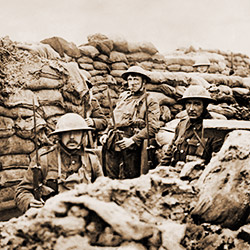
The armies dug networks of trenches protected by barbed wire, machine guns, and artillery positions.
-
Soldiers lived in mud, cold, dampness, and constant proximity to death.
-
Lice, rats, disease, and lack of sleep made conditions even worse.
-
Between the opposing lines lay “no man’s land,” an exposed area under enemy fire.
-
Attacks had to cross this ground under machine-gun and artillery fire.
-
Territorial gains were often extremely limited despite enormous losses.
-
The trenches became the main symbol of the war on the Western Front.
New Weapons
-
Artillery caused most battlefield deaths and injuries.
-
Machine guns allowed a small number of soldiers to fire rapidly against entire formations.
-
Poison gas was used on a large scale beginning in 1915.
-
Gas masks gradually reduced its effectiveness without eliminating the fear it caused.
-
Aircraft were first used to observe enemy positions, then for combat and bombing.
-
Tanks appeared in 1916 to cross trenches and barbed wire.
-
Submarines attacked military and commercial ships in an effort to weaken enemy supplies.
-
Technological innovations transformed warfare without immediately ending the stalemate.
Verdun and the Somme
-
In February 1916, Germany attacked Verdun, an important and highly symbolic French position.
-
Fighting lasted for most of the year and caused hundreds of thousands of casualties on both sides.
-
General Philippe Pétain organized the French defence and kept supplies moving along the “Sacred Way.”
-
The phrase “They shall not pass” became associated with the defence of Verdun.
-
In July 1916, British and French forces launched an offensive on the Somme to relieve pressure on Verdun.
-
The first day of the battle was one of the deadliest in the history of the British Army.
-
Tanks were used for the first time during the offensive, although only in limited numbers.
-
Both battles illustrated the brutality of a war of attrition in which losses far exceeded territorial gains.
The Eastern Front
-
The Eastern Front was much larger and more mobile than the Western Front.
-
In August 1914, the Germans won an important victory over the Russians at Tannenberg.
-
The Russian army suffered heavy losses but continued to mobilize millions of men.
-
In 1915, German and Austro-Hungarian forces pushed the Russians out of much of Poland.
-
In 1916, the Brusilov Offensive inflicted heavy losses on Austria-Hungary.
-
Economic difficulties, military defeats, and supply shortages gradually weakened the Russian Empire.
-
Romania joined the Allies in 1916, but its army was quickly pushed back by the Central Powers.
The Ottoman Empire and the Dardanelles
-
The Ottoman Empire controlled the straits connecting the Mediterranean Sea to the Black Sea.
-
In 1915, the Allies attempted to capture the Dardanelles and open a supply route to Russia.
-
British, French, Australian, and New Zealand forces landed on the Gallipoli Peninsula.
-
Ottoman resistance, command errors, and difficult conditions caused the operation to fail.
-
The Allies evacuated the peninsula in early 1916.
-
Mustafa Kemal distinguished himself in the Ottoman defence and later became the founder of modern Turkey.
-
British Empire forces also fought the Ottomans in Mesopotamia, Palestine, and the Arabian Peninsula.
The Armenian Genocide
-
Ottoman leaders collectively accused Christian Armenians of supporting Russia.
-
Beginning in 1915, the authorities arrested, deported, and massacred Armenian populations.
-
Hundreds of thousands of people died through executions, forced marches, starvation, and mistreatment.
-
Assyrians and Greeks within the Ottoman Empire also suffered deadly persecution.
-
The Armenian genocide was one of the major mass crimes of the First World War.
-
The Turkish government still officially disputes the use of the term genocide.
The War at Sea
-
The British navy imposed a blockade intended to deprive the Central Powers of food and raw materials.
-
The blockade contributed to shortages affecting German industry and civilians.
-
In May 1916, the British and German fleets fought at the Battle of Jutland.
-
Germany inflicted heavy losses but failed to break British naval dominance.
-
German submarines attacked ships carrying goods to Allied countries.
-
The passenger liner Lusitania was sunk in 1915, killing nearly 1,200 people.
-
The deaths of American passengers increased hostility toward Germany in the United States.
Civilians and the War Economy
-
Governments organized industrial production, controlled raw materials, and imposed restrictions.
-
Shortages led to rationing of food, coal, and other essential goods.
-
Women replaced many men in factories, transportation, offices, and agriculture.
-
They manufactured weapons and ammunition, often under dangerous conditions.
-
Civilians suffered bombing, occupation, displacement, and shortages.
-
Propaganda encouraged patriotism, portrayed the enemy as barbaric, and justified sacrifice.
-
Censorship limited information about defeats, losses, and actual conditions at the front.
Soldiers from the Colonial Empires
-
France recruited soldiers from North Africa, West Africa, Madagascar, and Indochina.
-
The United Kingdom mobilized major forces from Canada, Australia, New Zealand, India, and Africa.
-
Colonial labourers were also sent to Europe to support industry and logistics.
-
These men fought on several fronts and often faced discrimination.
-
Their participation strengthened political and nationalist demands in several colonies.
-
Canada gained greater international autonomy through its war effort.
-
The Battle of Vimy Ridge in April 1917 occupies an important place in Canadian memory.
Mutinies and War Weariness
-
After several years of fighting, soldiers and civilians were exhausted.
-
Repeated losses made major offensives increasingly unacceptable.
-
In 1917, mutinies broke out in several French units after the failure of the Nivelle Offensive.
-
Soldiers mainly refused to take part in further attacks considered pointless, but they generally continued to defend their positions.
-
General Pétain improved leave, supplies, and service conditions while punishing some leaders.
-
Strikes and antiwar demonstrations also appeared in several countries.
The Russian Revolutions
-
In March 1917, demonstrations and military mutinies caused the fall of Tsar Nicholas II.
-
A provisional government took power but decided to continue the war.
-
The Russian army continued to disintegrate because of desertion and political conflict.
-
In November 1917, the Bolsheviks led by Vladimir Lenin overthrew the provisional government.
-
They promised peace, land for the peasants, and power to the soviets.
-
Russia signed the Treaty of Brest-Litovsk with the Central Powers in March 1918.
-
It surrendered vast territories, allowing Germany to transfer soldiers to the Western Front.
The United States Enters the War
-
The United States remained officially neutral during the first years of the conflict.
-
It nevertheless supplied goods, loans, and equipment mainly to the Allied powers.
-
In 1917, Germany resumed unrestricted submarine warfare against ships approaching enemy ports.
-
The Zimmermann Telegram revealed a German proposal for an alliance with Mexico against the United States.
-
President Woodrow Wilson asked Congress to declare war on Germany.
-
The United States officially entered the conflict on April 6, 1917.
-
American troops gradually arrived in Europe and became numerous during 1918.
The German Offensives of 1918
-
After Russia withdrew, Germany attempted to win the war before large numbers of American troops arrived.
-
In March 1918, it launched a series of major offensives on the Western Front.
-
New tactics used assault groups to infiltrate enemy lines and bypass strong defensive points.
-
The Germans achieved their largest advances since 1914.
-
They failed, however, to destroy the Allied armies or win a decisive victory.
-
Losses were extremely heavy among Germany’s most experienced soldiers.
-
Supply problems, exhaustion, and the arrival of American troops eventually stopped the offensive.
The Allied Counteroffensive
-
In July 1918, the Allies stopped the final German offensive during the Second Battle of the Marne.
-
They then went on the attack under better coordinated command.
-
Tanks, aircraft, artillery, and infantry were used more effectively together.
-
Beginning in August, the Hundred Days Offensive gradually pushed German forces back.
-
Canadian, Australian, British, French, and American troops participated in the attacks.
-
German soldiers retreated, surrendered in large numbers, and abandoned equipment.
-
Germany’s allies also collapsed in the Balkans, the Middle East, and Italy.
The Armistice
-
Bulgaria surrendered in September 1918, followed by the Ottoman Empire and Austria-Hungary.
-
In Germany, shortages, defeats, and mutinies caused a political crisis.
-
German sailors rebelled at Kiel, and the revolutionary movement spread to several cities.
-
Emperor Wilhelm II abdicated on November 9, 1918.
-
A republic was proclaimed in Berlin.
-
Germany signed an armistice with the Allies in a railway carriage at Rethondes.
-
Fighting ended on November 11, 1918, at 11 a.m.
-
The armistice suspended hostilities, but a final peace treaty still had to be negotiated.
Human Losses
-
The war caused the deaths of millions of soldiers.
-
Millions more were wounded, mutilated, traumatized, or reported missing.
-
Veterans suffering from psychological trauma were often poorly understood by medicine and society.
-
Civilians died in massacres, famines, bombings, deportations, and epidemics.
-
The influenza pandemic of 1918 spread among weakened populations and killed millions worldwide.
-
An entire generation was deeply marked by the losses and destruction.
The Treaty of Versailles
-
The peace conference opened in Paris in January 1919.
-
The defeated powers had little influence over the main negotiations.
-
The Treaty of Versailles was signed with Germany on June 28, 1919.
-
Germany had to accept responsibility for the conflict, limit its military, and pay reparations.
-
It lost territories in Europe as well as its colonies.
-
Alsace and Lorraine were returned to France.
-
The Rhineland was demilitarized and placed under supervision.
-
Many Germans viewed the treaty as a humiliation imposed by the victors.
The Transformation of Europe
-
The German, Austro-Hungarian, Russian, and Ottoman empires disappeared or were profoundly transformed.
-
New states appeared, including Poland, Czechoslovakia, and Yugoslavia.
-
Borders did not always correspond to the populations living within them.
-
National minorities found themselves incorporated into states they did not consider their own.
-
Ottoman territories in the Middle East were divided mainly into British and French spheres of influence.
-
The League of Nations was created to preserve peace through international cooperation.
-
The United States refused to join, weakening the organization.
The Legacy of the War
-
The First World War accelerated the decline of European dominance in the world.
-
The United States became an even more important economic and financial power.
-
Nationalist movements gained influence in several colonies.
-
The Bolshevik Revolution created the first lasting communist state.
-
Debt, reparations, and destruction permanently weakened European economies.
-
Frustration with the peace treaties contributed to the rise of authoritarian and nationalist movements.
-
In Germany, Adolf Hitler later exploited resentment over defeat and the Treaty of Versailles.
-
The peace settlement of 1919 therefore failed to resolve every tension and partly created the conditions that led to the Second World War.
Quiz questions preview
-
German attacks launched in March 1918 to overthrow the Allies before the arrival of American reinforcements.
The Spring Offensive | The Hundred Days Offensive | The Tannenberg Offensive | The Frontiers Offensive -
International institution created during the Treaty of Versailles in 1919 to settle international disputes.
The Inter-Parliamentary Union | The League of Nations | The International Peace Bureau | The United Nations -
German equipment replaced in 1916 due to its poor efficiency in combat.
The plastron | The boot | The Pickelhaube | The bayonet -
First to cross the Mediterranean by air, he also created a system that allows shooting through the propeller of an aircraft.
Louis Blériot | Jean Mermoz | Roland Garros | Charles Roissy -
German Chief of Staff, he resigned due to the heavy losses at Verdun and the disappointing results of 1916.
Erich von Falkenhayn | Helmuth von Moltke | August von Mackensen | Alfred von Schlieffen