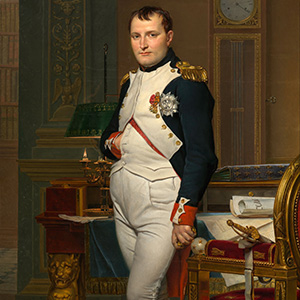

In the Time of Napoleon
When Napoleon Bonaparte took power in France in 1799, the country was emerging from ten years of revolution, political violence, and war against the European monarchies. A victorious general who became First Consul and later emperor, he profoundly reorganized the state, the legal system, the administration, and education. His armies dominated much of Europe before being exhausted by endless conflict. Admired for his military genius and reforms, Napoleon also remains associated with authoritarianism, warfare, and the restoration of slavery in the French colonies.
A Birth in Corsica
-
Napoleon Bonaparte was born on August 15, 1769, in Ajaccio, Corsica.
-
The island had been transferred to France by the Republic of Genoa the year before his birth.
-
His family belonged to the minor Corsican nobility and possessed more social prestige than wealth.
-
His father, Carlo Bonaparte, was a lawyer and briefly represented the Corsican nobility at the court of Louis XVI.
-
His mother, Letizia Ramolino, raised eight children who survived into adulthood.
-
Napoleon grew up in an environment still strongly shaped by Corsican language, traditions, and nationalism.
-
In his youth, he admired the independence leader Pasquale Paoli and initially thought of himself as Corsican rather than French.
Military Training
-
At the age of nine, Napoleon left Corsica to study in mainland France.
-
He first attended the military school at Brienne, where his Corsican accent and relatively modest noble background set him apart from many classmates.
-
He was particularly interested in history, geography, mathematics, and the great military leaders of Antiquity.
-
He continued his training at the École Militaire in Paris.
-
His father’s death forced the family to reduce expenses, and Napoleon completed his studies more quickly than usual.
-
In 1785, he became a second lieutenant of artillery in the French royal army.
-
Artillery required technical and mathematical knowledge that suited his abilities well.
The French Revolution
-
In 1789, the French Revolution gradually overthrew the institutions of the Ancien Régime.
-
Napoleon welcomed several revolutionary principles, including legal equality and advancement based on merit.
-
He frequently returned to Corsica, where political conflict eventually placed him in opposition to Pasquale Paoli.
-
In 1793, the Bonaparte family permanently left Corsica and took refuge on the mainland.
-
Napoleon moved closer to the Jacobins and benefited from the protection of Augustin Robespierre, brother of Maximilien Robespierre.
-
The Revolution allowed talented young officers to gain responsibilities that had once been reserved for the high nobility.
-
Napoleon took full advantage of this opportunity while adapting his alliances to changing political circumstances.
The Siege of Toulon
-
In 1793, the city of Toulon rebelled against the revolutionary government and opened its port to British and Spanish forces.
-
Napoleon was placed in command of the artillery of the army sent to recapture the city.
-
He understood that seizing certain commanding positions would allow the French to threaten enemy ships in the harbor.
-
His plan directly contributed to the withdrawal of foreign forces and the Republican victory.
-
After Toulon was retaken, Napoleon was promoted to brigadier general at only twenty-four years of age.
-
The episode revealed his talent for artillery, the concentration of forces, and the rapid analysis of terrain.
-
His career briefly slowed after the fall of Robespierre in 1794 because of his previous political connections.
The 13 Vendémiaire
-
In October 1795, Parisian royalists rose against the National Convention.
-
The government entrusted Napoleon with the defense of the Republican institutions.
-
He used artillery against the insurgents and quickly dispersed the uprising.
-
This intervention, often summarized by the expression “a whiff of grapeshot,” saved the government.
-
Napoleon was then promoted to general of division and commander of the Army of the Interior.
-
He became closer to Paul Barras, one of the principal leaders of the Directory.
-
This political victory allowed him to obtain command of the Army of Italy.
Joséphine de Beauharnais
-
In March 1796, Napoleon married Joséphine de Beauharnais, the widow of a general who had been guillotined during the Reign of Terror.
-
Joséphine was older than Napoleon and had important connections within Parisian society.
-
During his campaigns, Napoleon wrote her many passionate letters.
-
Their marriage was nevertheless marked by infidelity, separation, and the absence of a child together.
-
Joséphine already had two children, Eugène and Hortense de Beauharnais, whom Napoleon integrated into his political family.
-
She played an important role in the social life of the Consulate and the Empire.
-
Napoleon divorced her in 1809 in order to marry a princess capable of giving him a dynastic heir.
The Italian Campaign
-
In 1796, Napoleon took command of an Army of Italy that was poorly equipped and often unpaid.
-
He promised his soldiers victory, honor, and the wealth of enemy territories.
-
His forces successively defeated the armies of the Kingdom of Piedmont-Sardinia and Austria.
-
Napoleon used speed to separate his opponents and fight them one after another.
-
The victories at Lodi, Arcole, and Rivoli helped establish his reputation as an exceptional commander.
-
He imposed heavy financial contributions on conquered territories and sent numerous works of art to France.
-
The Treaty of Campo Formio, signed in 1797, confirmed French gains and temporarily ended the war against Austria.
-
Napoleon returned to Paris as a national hero and a political figure who had become difficult to control.
The Egyptian Campaign
-
In 1798, Napoleon led an expedition to Egypt in order to threaten British trade routes to India.
-
He won the Battle of the Pyramids against the Mamluk forces and occupied Cairo.
-
British Admiral Horatio Nelson, however, destroyed much of the French fleet at the Battle of the Nile.
-
Napoleon’s army was left isolated from France.
-
An expedition into Syria failed before the city of Acre.
-
The soldiers were also struck by disease, heat, and supply difficulties.
-
Napoleon secretly left Egypt in 1799 and placed General Kléber in command of the army.
-
Despite its military failure, the campaign was presented in France as a glorious adventure.
The Scholars in Egypt
-
Napoleon had brought engineers, artists, naturalists, mathematicians, and other scholars with his army.
-
They studied Egypt’s monuments, plants, animals, technologies, and geography.
-
Their work led to the publication of the monumental Description de l’Égypte.
-
In 1799, French soldiers discovered the Rosetta Stone near the town of Rashid.
-
Its inscription, repeated in hieroglyphs, Demotic, and Greek, later allowed Jean-François Champollion to decipher hieroglyphic writing.
-
The expedition contributed to the development of European Egyptology.
-
It also formed part of the political and cultural appropriation of Egyptian heritage by European powers.
The Coup of Brumaire
-
When he returned to France, Napoleon found the Directory weakened, unpopular, and threatened by military defeats.
-
Several leaders were seeking a general capable of supporting a change of government.
-
On November 9 and 10, 1799, corresponding to 18 and 19 Brumaire in the revolutionary calendar, Napoleon took part in a coup d’état.
-
The legislative assemblies were moved to Saint-Cloud on the pretext of protecting them from a conspiracy.
-
Faced with opposition from certain deputies, Napoleon had to rely on soldiers to disperse the Council of Five Hundred.
-
The Directory was replaced by the Consulate.
-
A new constitution formally established three consuls but in practice gave most of the power to Napoleon, who became First Consul.
-
The coup ended the most unstable phase of the Revolution without restoring the monarchy.
The First Consul
-
Napoleon declared that the Revolution was over and that order now had to be restored.
-
He preserved several revolutionary achievements, including equality before the law, the abolition of feudal privileges, and access to office based on merit.
-
He nevertheless concentrated executive power in his own hands and reduced the independence of the assemblies.
-
Prefects appointed by the government were placed in charge of administering the departments.
-
The police monitored opponents, the press was censored, and elections were tightly controlled.
-
Popular consultations known as plebiscites gave a democratic appearance to decisions already made by the regime.
-
Napoleon was appointed consul for life in 1802.
-
The Consulate therefore combined certain modern reforms with an increasingly authoritarian government.
The Civil Code
-
The Revolution had abolished many old laws, but legal rules still varied from one region to another.
-
Napoleon ordered the preparation of a unified body of civil law, adopted in 1804 as the Civil Code of the French.
-
The text confirmed legal equality among men, private property, freedom of contract, and the end of privileges based on birth.
-
It guaranteed to property owners the lands and possessions acquired during the Revolution.
-
The Code nevertheless strengthened the authority of fathers and husbands within the family.
-
Married women had far fewer legal rights than men.
-
Divorce remained possible, but the rules were more favorable to husbands.
-
The Civil Code, later known as the Napoleonic Code, influenced the law of many countries in Europe and the Americas.
Administration and Finance
-
Napoleon centralized the French administration and placed civil servants under the direct authority of the government.
-
Prefects represented the state in the departments and supervised the police, public works, and tax collection.
-
The Bank of France was created in 1800 to stabilize credit and public finances.
-
A new currency, the germinal franc, was established in 1803 and maintained a reputation for stability for many years.
-
The government improved tax collection and restored public finances more firmly.
-
Roads, bridges, canals, ports, and administrative buildings were constructed or modernized.
-
The Court of Audit was created to oversee the use of public funds.
-
This centralized organization left a lasting mark on French institutions.
Education and Merit
-
Napoleon viewed education as a means of training civil servants, officers, and citizens loyal to the regime.
-
He developed the lycées, secondary schools intended mainly for boys.
-
The curriculum emphasized mathematics, Latin, history, discipline, and preparation for state service.
-
Scholarships allowed some students from modest families to continue their studies.
-
The Imperial University, created in 1806, placed the entire education system under government control.
-
Education for girls remained much less developed and was often left to families or religious institutions.
-
The regime promoted merit but also sought to create a new administrative and military elite loyal to Napoleon.
The Concordat with the Church
-
The Revolution had deeply divided France over religion.
-
In 1801, Napoleon concluded an agreement with Pope Pius VII known as the Concordat.
-
Catholicism was recognized as the religion of the majority of French people without again becoming the official state religion.
-
The government appointed bishops, while the pope granted them religious authority.
-
Members of the clergy received salaries from the state and were required to swear loyalty to it.
-
The Church agreed not to demand the return of property confiscated during the Revolution.
-
Napoleon unilaterally added the Organic Articles, which strengthened state control over religious activity.
-
The Concordat helped reconcile part of the Catholic population with the new regime.
The Restoration of Slavery
-
The National Convention had abolished slavery in the French colonies in 1794.
-
In 1802, Napoleon’s government restored slavery in several colonies where abolition had not been fully enforced or had been challenged.
-
The decision reflected the economic interests of plantation owners and the desire to rebuild the French colonial empire.
-
In Guadeloupe, French forces brutally suppressed resistance led by Louis Delgrès.
-
In Saint-Domingue, the expedition sent against Toussaint Louverture failed because of local resistance and disease.
-
Toussaint Louverture was captured, deported to France, and died in prison in 1803.
-
The colony declared its independence in 1804 under the name Haiti.
-
The defeat in Saint-Domingue helped persuade Napoleon to sell Louisiana to the United States in 1803.
From Consul to Emperor
-
Royalist plots and the desire to stabilize the succession strengthened plans for a hereditary monarchy.
-
In May 1804, Napoleon was proclaimed Emperor of the French.
-
His title did not present him as the owner of a kingdom but as the sovereign of a nation born from the Revolution.
-
The coronation took place on December 2, 1804, in Notre-Dame Cathedral in Paris.
-
Pope Pius VII attended the ceremony, but Napoleon crowned himself before crowning Joséphine.
-
This gesture symbolized that his authority did not depend solely on the Church.
-
Painter Jacques-Louis David transformed the ceremony into a vast official image of the new dynasty.
-
Napoleon distributed titles and honors to his relatives, generals, and most faithful servants.
A New Nobility
-
Napoleon created an imperial nobility intended to reward military and administrative service.
-
The titles of prince, duke, count, baron, and knight were granted according to a precise hierarchy.
-
This nobility did not formally restore the feudal privileges abolished by the Revolution.
-
It nevertheless formed a new elite based on proximity to the emperor, public office, and military victory.
-
Napoleon placed several members of his family on European thrones.
-
Joseph Bonaparte became King of Naples and later King of Spain, while Louis Bonaparte ruled Holland.
-
Jérôme Bonaparte received the Kingdom of Westphalia, and Caroline Bonaparte became Queen of Naples alongside Joachim Murat.
-
These appointments strengthened family influence but also caused rivalries and local resistance.
The Grande Armée
-
Napoleon’s army relied heavily on conscription introduced during the Revolution.
-
Hundreds of thousands of young men were called into military service during the Empire.
-
Napoleon organized his forces into army corps capable of moving separately and quickly gathering for battle.
-
Each corps included infantry, cavalry, artillery, and support services.
-
This organization gave the army great strategic flexibility.
-
Napoleon sought to concentrate superior forces rapidly against one section of the enemy army.
-
His soldiers endured long marches and often lived off the resources of the territories they crossed.
-
The marshals of the Empire, including Davout, Lannes, Ney, Masséna, Soult, and Murat, played an essential role in his campaigns.
Austerlitz
-
In 1805, the United Kingdom, Austria, and Russia formed a new coalition against France.
-
Napoleon abandoned his planned invasion of England and rapidly moved the Grande Armée into Central Europe.
-
He forced an Austrian army to surrender at Ulm.
-
On December 2, 1805, exactly one year after his coronation, he faced the Russian and Austrian armies at Austerlitz.
-
Napoleon deliberately weakened part of his position to encourage the enemy to attack.
-
The French then retook the Pratzen Heights and split the opposing army.
-
The Battle of Austerlitz is generally regarded as one of his greatest victories.
-
Austria asked for peace, and the Holy Roman Empire disappeared the following year.
The Domination of Europe
-
After Austerlitz, Napoleon reorganized part of Germany by creating the Confederation of the Rhine.
-
In 1806, Prussia entered the war against France.
-
The Prussian armies were crushed at the battles of Jena and Auerstedt.
-
Napoleon entered Berlin and continued the war against Russia in Poland.
-
The Battle of Eylau in February 1807 was extremely bloody and produced no clear victory.
-
In June, the French victory at Friedland forced Tsar Alexander I to negotiate.
-
The Treaties of Tilsit temporarily established an alliance between France and Russia.
-
At its height, Napoleon’s empire directly or indirectly controlled much of continental Europe.
The Continental System
-
Napoleon could not directly defeat the United Kingdom because of the superiority of the Royal Navy.
-
In 1805, the combined French and Spanish fleet had been destroyed by Admiral Nelson at Trafalgar.
-
Napoleon therefore tried to weaken the British economy by forbidding European ports from trading with Britain.
-
This policy, known as the Continental System, was introduced beginning in 1806.
-
It encouraged certain European industries but also caused shortages, smuggling, and resentment among merchants.
-
Allied countries found the restrictions imposed by France difficult to endure.
-
The attempt to enforce the blockade drew Napoleon into further military interventions.
-
The system never succeeded in ruining the British economy.
The Peninsular War
-
In 1807, French troops crossed Spain in order to invade Portugal, which refused to enforce the Continental System.
-
Napoleon took advantage of a crisis within the Spanish royal family to remove the king and place his brother Joseph on the throne.
-
An uprising broke out in Madrid on May 2, 1808, before spreading across the country.
-
The French faced popular resistance supported by guerrilla fighters.
-
The word “guerrilla” then entered international use to describe a form of small-scale warfare conducted by mobile groups.
-
British forces commanded by Arthur Wellesley, the future Duke of Wellington, intervened in the Iberian Peninsula.
-
The fighting, reprisals, and massacres were depicted by the painter Francisco de Goya.
-
The Peninsular War tied down hundreds of thousands of French soldiers and permanently weakened the Empire.
Marie Louise and the Heir
-
After divorcing Joséphine, Napoleon sought a new wife among Europe’s great dynasties.
-
In 1810, he married Marie Louise of Austria, daughter of Emperor Francis I.
-
The marriage was intended to bring France closer to Austria and give the Empire dynastic legitimacy.
-
In 1811, Marie Louise gave birth to a son, Napoleon François Joseph Charles.
-
The child received the title King of Rome.
-
Napoleon believed that he had secured the continuity of his dynasty.
-
After the fall of the Empire, Marie Louise returned to her family in Austria.
-
Napoleon’s son lived there as Duke of Reichstadt and died in 1832 at the age of twenty-one.
The Russian Campaign
-
Relations between Napoleon and Tsar Alexander I deteriorated because of the Continental System and their competing ambitions.
-
In June 1812, Napoleon invaded Russia with an army of several hundred thousand men drawn from many European countries.
-
The Russians retreated while destroying resources to prevent the French from obtaining supplies.
-
The Battle of Borodino was one of the bloodiest battles of the Napoleonic Wars.
-
Napoleon entered Moscow in September but found the city largely abandoned and devastated by fires.
-
The tsar refused to ask for peace.
-
Napoleon finally ordered a retreat as winter approached.
-
Cold, hunger, disease, Russian attacks, and exhaustion destroyed much of the Grande Armée.
-
The crossing of the Berezina allowed some survivors to escape encirclement but became a symbol of the disaster.
The Fall of the Empire
-
After the Russian disaster, Prussia, Russia, Austria, and several other states joined a new coalition.
-
Napoleon quickly rebuilt an army but lacked experienced soldiers and horses.
-
In October 1813, he was defeated at Leipzig in the “Battle of the Nations.”
-
Allied armies then invaded France.
-
Napoleon still won several battles during the 1814 campaign in France but could not stop overwhelmingly superior forces.
-
Paris surrendered at the end of March.
-
The marshals refused to continue the war and forced the emperor to abdicate.
-
Napoleon was sent to the island of Elba, where he retained symbolic sovereignty.
-
Louis XVIII, brother of Louis XVI, became King of France.
The Hundred Days
-
Napoleon escaped from Elba in February 1815 and landed in southern France.
-
The soldiers sent to arrest him gradually joined his side.
-
Louis XVIII fled Paris, and Napoleon regained power without a major battle.
-
This period, known as the Hundred Days, immediately alarmed the European powers.
-
Napoleon attempted to present his new regime as more liberal but above all had to prepare for another war.
-
He entered Belgium in order to defeat the British and Prussian armies separately.
-
On June 18, 1815, he faced Wellington’s army at Waterloo.
-
The arrival of Prussian forces commanded by Blücher contributed to the French defeat.
-
Napoleon abdicated a second time a few days later.
Exile on Saint Helena
-
Napoleon hoped to obtain asylum in the United Kingdom, but the British decided to remove him permanently from Europe.
-
He was sent to Saint Helena, an isolated island in the South Atlantic.
-
He lived there under supervision at Longwood House.
-
Napoleon spent part of his exile dictating his memoirs and presenting his own version of history.
-
He sought to create the image of a modern ruler, defender of the principles of the Revolution, and victim of the European monarchies.
-
His relationship with the British governor Hudson Lowe was extremely poor.
-
His health gradually deteriorated.
-
Napoleon died on May 5, 1821, probably from stomach cancer.
-
His body was returned to France in 1840 and placed beneath the dome of Les Invalides in Paris.
The Main Figures Around Him
-
Joséphine de Beauharnais was Napoleon’s first wife and empress until their divorce.
-
Marie Louise of Austria became his second wife and the mother of his only legitimate son.
-
Charles-Maurice de Talleyrand was an exceptional diplomat who served several regimes but eventually opposed the emperor’s policy of conquest.
-
Joseph Fouché, Minister of Police, developed a vast surveillance network and also managed to survive numerous changes of government.
-
Jean-Jacques-Régis de Cambacérès played an important role in drafting the Civil Code and administering the Consulate.
-
Louis-Alexandre Berthier, chief of staff, transformed Napoleon’s strategic decisions into precise orders for the armies.
-
Joachim Murat, the emperor’s brother-in-law, distinguished himself as a cavalry commander before becoming King of Naples.
-
Jean Lannes, Louis-Nicolas Davout, Michel Ney, André Masséna, and Jean-de-Dieu Soult were among his leading marshals.
Propaganda and the Napoleonic Legend
-
Napoleon understood very early the importance of controlling his public image.
-
Army bulletins described the campaigns while often exaggerating victories and minimizing losses.
-
Newspapers were monitored and could not freely publish criticism of the regime.
-
Paintings by Jacques-Louis David and Antoine-Jean Gros represented Napoleon as a hero, lawgiver, or providential ruler.
-
Monuments, medals, ceremonies, and triumphal arches connected the Empire with the grandeur of ancient Rome.
-
After his fall, his memoirs and the accounts of former soldiers helped create the legend of a commander close to his men.
-
Romantic writers helped transform his life into an epic story of ascent, glory, defeat, and exile.
-
This legend had a lasting influence on nineteenth-century French politics and culture.
The Limits and Contradictions of His Rule
-
Napoleon consolidated several principles of the Revolution while eliminating much political freedom.
-
He promoted advancement based on merit but created a new nobility and placed his relatives on foreign thrones.
-
He modernized the legal and administrative systems but strengthened inequality between men and women.
-
He stabilized public finances, but his wars imposed heavy contributions on European populations.
-
He claimed to free peoples from old feudal institutions but often imposed French domination upon them.
-
The restoration of slavery directly contradicted the principles of equality proclaimed by the Revolution.
-
Conscription removed millions of men from their families and provoked resistance in several regions.
-
The Napoleonic Wars caused enormous losses among soldiers and civilians.
France Under Napoleon
-
France remained mainly rural, although Paris and several regional cities continued to grow.
-
Most inhabitants lived from agriculture and depended directly on the harvests.
-
The Revolution had allowed many peasants to acquire land formerly owned by the Church or the nobility.
-
Napoleon protected these new properties and prevented a complete return to the Ancien Régime.
-
The administrative, legal, and commercial middle classes occupied an increasingly important place in society.
-
Workers did not have the right to freely form associations or strike.
-
The workers’ passbook allowed the authorities and employers to monitor the movements of certain laborers.
-
The wars stimulated industries connected with uniforms, weapons, and military supplies but also disrupted trade.
-
Families bore the burden of conscription, taxation, and military deaths.
Arts and Culture
-
The regime encouraged an official style inspired by ancient Rome, known as the Empire style.
-
Eagles, laurel wreaths, columns, sphinxes, and references to ancient emperors were widely used.
-
Jacques-Louis David became Napoleon’s leading official painter.
-
Antoine-Jean Gros depicted several military campaigns in dramatic compositions.
-
Architects Percier and Fontaine helped define the interiors, furniture, and buildings of the period.
-
The Arc de Triomphe du Carrousel, the Vendôme Column, and several other monuments celebrated the victories of the Empire.
-
Works of art seized in conquered territories enriched the Louvre, then known as the Musée Napoléon.
-
After the defeat of 1815, several countries demanded the return of works taken by the French armies.
Europe in Napoleon’s Time
-
Europe was still dominated by hereditary monarchies, but the ideas of the French Revolution challenged traditional privileges.
-
French conquests abolished or reformed many feudal institutions.
-
The Civil Code and centralized administrations were introduced in numerous territories.
-
The wars contributed to the growth of nationalism in Germany, Spain, Italy, Poland, and elsewhere.
-
The United Kingdom financed several coalitions against Napoleon and used its naval power to protect its global trade.
-
The Industrial Revolution advanced in Britain through coal, steam power, and the mechanization of textile production.
-
Russia remained a vast agricultural empire based largely on serfdom.
-
Austria ruled over many different peoples in Central Europe and sought to preserve dynastic order.
-
Prussia reformed its army, administration, and educational system after its defeats in 1806.
-
The Congress of Vienna, convened after Napoleon’s fall, redrew borders and attempted to restore a balance among the great powers.
The Americas in Napoleon’s Time
-
The United States was still a young republic led in succession by John Adams, Thomas Jefferson, and James Madison.
-
In 1803, the Louisiana Purchase from France nearly doubled the territory of the United States.
-
Napoleon sold this immense region because he needed money and could no longer maintain a large empire in North America.
-
The Haitian Revolution led to the creation of the first independent state born from a successful slave uprising.
-
In Spanish America, the European wars weakened Madrid’s authority.
-
Independence movements developed under leaders such as Simón Bolívar, José de San Martín, and Miguel Hidalgo.
-
Brazil temporarily became the center of the Portuguese Empire when the royal family fled Lisbon to escape the French armies.
-
The War of 1812 pitted the United States against the United Kingdom while Europe was fighting Napoleon.
The World in Napoleon’s Time
-
The Ottoman Empire still controlled much of the Balkans, Anatolia, and the Near East despite growing internal difficulties.
-
In Egypt, Muhammad Ali gradually established an almost independent government and began modernizing the army and administration.
-
Persia was ruled by the Qajar dynasty and faced competing pressure from Russia and the United Kingdom.
-
In India, the British East India Company expanded its authority after defeating several local powers.
-
China was ruled by the Qing dynasty under the Qianlong and later the Jiaqing emperors.
-
Japan remained under the Tokugawa shogunate and severely restricted relations with foreign countries.
-
In West Africa, the Sokoto Caliphate was founded in the early nineteenth century following a major religious and political movement.
-
The transatlantic slave trade continued, although the United Kingdom prohibited it within its empire in 1807.
-
European explorers, merchants, and colonial powers increased their expeditions in the Pacific, Africa, and Asia.
-
The Napoleonic Wars were primarily European, but their economic, political, and colonial consequences were felt across several continents.
Quiz questions preview
-
What title did Napoleon hold when he ratified the Concordat of 1801 with Pope Pius VII?
Prince | First Consul | Emperor | King -
Birthplace of the Industrial Revolution, where the first steam locomotive appeared in 1804, year of Napoleon's coronation.
England | Germany | France | United States -
Names of the only child of Napoleon and Marie-Louise of Austria, the later Napoleon II.
Napoléon Louis Hugues Philippe | Napoléon François Charles Joseph | Napoléon Albert Charles Philippe | Napoléon Pierre Henri Jean -
What was the name of the southern continent before British navigator Matthew Flinders renamed it "Australia" in 1814?
New Holland | Batavia | South India | Ceylan -
Which of these figures was contemporary with Napoleon?
Jules Verne | Ludwig Van Beethoven | John Locke | Claude Debussy